A.1 Derivatives of Constant, Linear, & Power Functions
Let's use Desmos to explore derivatives of the most basic of functions: I. Constant; II. Linear; and III. Power Functions. We'll develop a simple rule to quickly determine each, and the of course practice using each rule to quickly find the derivative.
I. Constant Functions
We consider first constant functions:
Exploration 1: Compare derivatives of constant functions
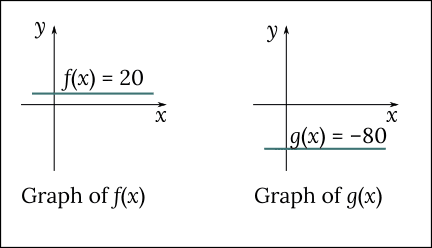
To start focus on the rate at which the first function,
Now think about
When you have your answers in mind, open the area below to use the interactive Desmos calculator to check your reasoning.
As Exploration 1 demonstrates,
Derivative of Constant Functions
Here are three ways to make sense of this result:
- The derivative is the rate of change of the function. Since the function
𝑓 ( 𝑥 ) = 𝑐 - The value of the derivative at any point is the slope of the tangent line to the curve
𝑦 = 𝑓 ( 𝑥 ) - We can obtain this result using the definition of the derivative:
Let's do one quick Practice Problem to help solidify this result:
II. Linear Functions
Let's consider next linear functions, which we'll write in the familiar form
Exploration 2: Compare derivatives of linear functions

Examine the graphs of the two linear functions

Next, examine the graphs of the two linear functions
When you have your answers in mind, open the are below to use an interactive Desmos calculator to check your reasoning.
As Exploration 2 demonstrates,
Derivative of Linear Functions
If
Here are three ways to make sense of this result:
The derivative is the rate of change of the function. By definition, a linear function changes at the constant rate given by its slope, m. The function's y-intercept doesn't matter; that value just tells us one point on the line,
( 0 , 𝑏 ) , We can visualize this result more clearly by tying it back to Leibniz notation, as shown in the following graph.
The value of the derivative at any point is the slope of the tangent line to the curve at that point. For a linear function, the tangent line to the "curve" is the line itself. Hence the derivative is simply equal to the line's slope.
We can obtain this result using the definition of the derivative:
We have
𝑓 ( 𝑥 ) = 𝑚 𝑥 + 𝑏 𝑓 ( 𝑥 + ℎ ) = 𝑚 ( 𝑥 + ℎ ) + 𝑏 = 𝑚 𝑥 + 𝑚 ℎ + 𝑏 Hence
𝑓 ′ ( 𝑥 ) = l i m ℎ → 0 𝑓 ( 𝑥 + ℎ ) − 𝑓 ( 𝑥 ) ℎ = l i m ℎ → 0 ( 𝑚 𝑥 + 𝑚 ℎ + 𝑏 ) − ( 𝑚 𝑥 + 𝑏 ) ℎ = l i m ℎ → 0 𝑚 ℎ ℎ = l i m ℎ → 0 𝑚 = 𝑚 ✓
III. Power Functions
Let's consider now functions of the form
 Do you notice a pattern in how the derivative functions are related to the original functions? Look at this table for more examples, and the last entry, which shows how to summarize the pattern:
 Proof that if
Hence we have shown that, for integer values of n, the derivative of the function
The rule also holds for negative integer values of n, but we must wait until later in the course when we have more tools to be able to prove that this is so. [Link to proof to be added.]
Furthermore, later we'll also be able to show [Link to be added] that the rule also holds for fractional values of n, such as:
But wait, there's more [Link again to be added]: the rule also holds for decimal values of n that can be expressed as a fraction (e.g.,
And finally, the rule also holds [Final link to be added] for non-rational values of n (values that cannot be expressed as a fraction) such as
Hence, the rule holds for all real values of n. Although we haven't proven it fully yet, from this point onward we will use the general rule, known as the Power Rule:
Power Rule
If
As you can imagine, you will use this rule quite frequently. Happily it's easy to use, and remember!
You can see the graph of
Exploration 3: Graphs of
The upper graph below shows the function
The graph underneath shows the derivative function
The first three Practice Problems below are straightforward applications of the Power Rule. The next few provide practice at "find the derivative" as the first step in writing the equation for a tangent line to a curve, one of the most common homework (and exam!) questions you'll encounter.
We're interested in the point
Step 2. Find the value of the derivative at the point of interest,
Since
The equation of the tangent line to a curve is given by
Let's revisit a problem from Chapter 1, where we found the linear approximation to
Consider the square-root function
View/Hide Solution
Our solution requires the rate at which the function changes at
We thus need the Power Rule, as applied to
That's the rate we simply had to provide back in Chapter 1, but now we know how to compute it. Once we have this rate, the solution is identical to that from Chapter 1:
For reference, the actual numeric value to 6 decimal places is
You can use the interactive Desmos graph below to explore this result graphically. Once again, visuals for dx and df will appear once you have zoomed-in sufficiently, which you must do to start. You can also try out different values of dx by using the slider beneath the graph.
On the next screen we'll add to our toolkit of derivatives we can quickly compute, by examining the exponential function
Of course if you have questions or thoughts about anything on this screen, please let us know on the Forum!
The Upshot
- Constant Function: If
𝑓 ( 𝑥 ) = 𝑐 , 𝑓 ′ ( 𝑥 ) = 0 . - Linear Function: If
𝑓 ( 𝑥 ) = 𝑚 𝑥 + 𝑏 , 𝑓 ′ ( 𝑥 ) = s l o p e = 𝑚 . - Power Rule: If
𝑓 ( 𝑥 ) = 𝑥 𝑛 , 𝑓 ′ ( 𝑥 ) = 𝑛 𝑥 𝑛 − 1 .
The derivatives of the following functions are:
How helpful was this page?
Our goal is to provide the best content we can, for free to any student looking to learn well, and your feedback helps us improve.