B.3 Factor to Find a Limit
Let's see how we can frequently factor to find a limit. This is the tactic you will use most often to compute limits, so practice using our problems with complete solutions.
We'll begin by continuing with the example we introduced at the bottom of the previous screen, and see how we can use the simple algebraic tactic of factoring to find the limit we're after.
Example 1:
Find
Solution.
Step 1. Try Substitution.
We always try Substitution first, as we did at the bottom of the preceding screen:
Step 2. Factor and simplify.
Let's factor the numerator of our function:
Step 3. Now easy Substitution to finish:
Why does this approach work?
Notice that the function
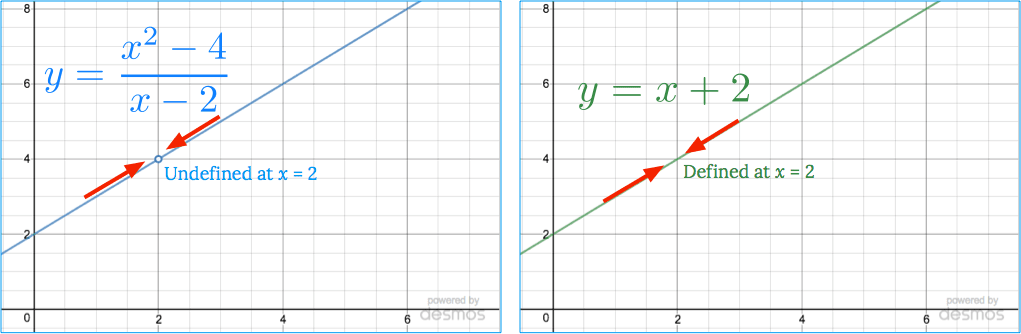
By comparing the two graphs, you can see why the limits are the same: whether or not the function is defined at
[If you'd like to revisit the interactive Desmos graph for this limit, it's the very first one we looked at in our Limits Introduction.]
As you will see in many, many problems to come, we will use this basic technique often: through algebraic manipulation, we are able to rewrite a function that isn't defined at the point of interest and "turn it into" a different form that is defined at the point of interest. Simple substitution then works to know the value of the function at that point, which in turn is the limit of the function at that point.
The rewritten function is not the same as the initial function
There is an important subtlety here: the two functions in the graphs above are not the same because they have different domains: the original function,
More generally, we have the incredibly helpful rule:
If
The rule merely encapsulates the reasoning we used above, and will use time and again.
This is almost the only time we'll discuss this subtlety. But please keep in mind that the algebraic manipulations you'll do in almost every problem allow us to find the limit of the original function only because of the way the limit is defined to focus on the behavior of the function close to, rather than at, the point of interest.
You saw in Example 1 above the three simple steps for the tactic of factoring to find a limit:
PROBLEM-SOLVING TACTIC: Factor to find a limit
- Try Substitution. As we saw on the preceding screen, if it works as a tactic, you're done. If, by contrast, you obtain
0 0 , - Factor and simplify. If you can factor the numerator and/or denominator, do so. You'll almost always find that the problematic term in the denominator cancels, and you'll be left with a new function for which you can use. . .
- Substitution to finish.
Practice the tactic of factoring to find the limit in the next few problems. These are straightforward once you learn to recognize what to do.
Practice Problems: Factor to Find a Limit
 Every Calculus exam that we've ever seen that includes limits as a topic has at least one problem that requires this tactic. Practice accordingly to be prepared.
Factor to Find a Limit: Scaffolded Exercise #1
Find
Solution.
Step 1. First try substitution:
Step 2. Factor and simplify:
Step 3. Substitution to finish:
Factor to Find a Limit: Scaffolded Exercise #2
Find
Solution.
Step 1. First try substitution:
Step 2. Factor and simplify:
Step 3. Substitution to finish:
Time to practice, especially because you can be sure that you'll see a problem like this on your next exam.
The Upshot
- If when you try Substitution you obtain
0 0 ,
On the next screen we'll explain another tactic you'll need often to compute a limit, using conjugates.
Does factoring as a tactic help you solve limit problems? Do you have additional tips to share? Let our learning community know by posting on the Forum!
How helpful was this page?
Our goal is to provide the best content we can, for free to any student looking to learn well, and your feedback helps us improve.