C.8 Limits at Infinity with Square Roots
On this screen we look at a very particular type of problem, one where you're finding a limit at infinity with a square root in the function.
There are no new concepts here. There are, however, some useful manipulations you should know about to be able to find these limits.
Content Note
Not all courses require you to be able to find limits at
Let's say upfront: unlike the limits we've examined on the proceeding few screens where dominance was clear, when you're looking at a function that involves square roots it is very difficult to immediately know what the limit is as
Fortunately, those same techniques will prove useful for the problems on this screen as well, as we'll see in the following example that looks at a function's behavior as
Example 1:
Find
Solution.
As we've done throughout this Section when working to formally find the limit as
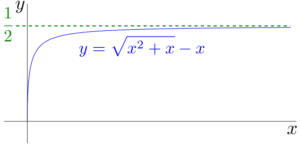
You can use the interactive calculator below to see how the function's curve mimics the horizontal asymptote
Example 1 is straightforward enough, and we'll let you try some practice problems below to find the limit at infinity with square roots, since moving the
Quick discussion of a subtle and important issue as 𝑥 → − ∞
But before then, let's address the one tricky issue that arises when we look at
Now, to illustrate the issue, let's consider the particular value
What just happened?!? Actually, what we just saw is useful to remember: one way to define the absolute value of a number is to take the (positive) square-root of that number's square:
But in our situation, with
One way to frame this whole issue is that if you have the equation
If this discussion seems abstract, please just continue on to the following example where we'll see how this substitution works in practice as we determine the limit as
Example 2:
Find
Solution.
Before we do anything else, let's look at the function and decide whether we expect the limit — if it exists (as it typically does in these problems) — will be positive or negative. We can reason quickly: looking at
As usual, we first divide the numerator and denominator both by x-to-the-largest-power in the denominator, which here is x. Note that to move the x in the numerator underneath the square root sign, we use the fact that since we're concerned only with negative values of x, we have
We highlighted the negative sign in every step after we introduced it so you can see how it directly gives us the negative result we expect and that is correct: the limit as
Let's summarize the approaches we used in Examples 1 and 2:
PROBLEM-SOLVING TACTIC: Find the limit at infinity with square roots
- As a first step, divide both the numerator and the denominator by x-to-the-largest-power that is in the denominator.
- You already know
𝑥 = ± √ 𝑥 2 . F o r 𝑥 → ∞ : 𝑥 = √ 𝑥 2 F o r 𝑥 → − ∞ : 𝑥 = − √ 𝑥 2 𝑥 → − ∞ ,
Of course the only way to really get this down is to practice, so here are some problems to try — each of course with a complete solution.
Practice Problems: Limits at Infinity with Square Roots
View/Hide Solution
- (a)
√ 5 - (b)
− √ 5
We use our usual "trick" of dividing the numerator and the denominator by the largest term in the denominator, which here is
Note that since we're looking at
Note that in the last step, we used the fact that

We can verify the result with a quick look at the graph of the function. Note that the horizontal line
Before we do anything else, let's look at the function and decide whether we expect the limit — if it exists (as it typically will in these problems) — will be positive or negative. We can reason quickly: in
To obtain that result, we again use our usual "trick" of dividing the numerator and the denominator by the largest term in the denominator, which here is
The crucial part of this solution: since we're looking at
Note that in the last step, we used the fact that
We can verify the result with a quick look at the graph of the function. Note that the horizontal line

Notice that we obtained a negative number as our answer, which matches our quick initial reasoning above.
The Upshot
This is a screen about the technique for how to find the limit in a very particular case, when you're computing the limit at infinity of a function with a square root. Repeating the key new problem-solving steps from above:
- As a first step, divide both the numerator and the denominator by x-to-the-largest-power that is in the denominator.
- You already know
𝑥 = ± √ 𝑥 2 . F o r 𝑥 → ∞ : 𝑥 = √ 𝑥 2 F o r 𝑥 → − ∞ : 𝑥 = − √ 𝑥 2 𝑥 → − ∞ ,
These problems can be tricky! If you need help, please pop over to the Forum and ask. (The easy-to-use math editor there will even make it simple to recreate your question with nice equation rendering for us all to see and be able to understand what can be complicated-looking functions.)
[What's below repeats from the preceding screen, in case you had to delay finishing this Section until after including this screen.]This concludes our exploration of limits at
In the next section, we'll take up the important concept of "continuity" and "continuous functions," along with the related "Intermediate Value Theorem." We'll see you there. :)
How helpful was this page?
Our goal is to provide the best content we can, for free to any student looking to learn well, and your feedback helps us improve.