Mean Value Theorem
On this placeholder page we present the essentials of using the Mean Value Theorem and Rolle's Theorem. Then below we have typical problems, each with a complete solution immediately available, so you can see how they are used routinely, including in some typical exam questions. Let's jump right in!
MATHENO ESSENTIALS: Mean Value Theorem & Rolle's Theorem
Mean Value Theorem
If
or, equivalently,
In words: there is at least one value

Rolle's Theorem
In Calculus texts and lecture, Rolle's theorem is given first since it's used as part of the proof for the Mean Value Theorem (MVT). You can easily remember it, though, as just a special case of the MVT: it has the same requirements about continuity on

The problems below illustrate some typical uses of the Mean Value Theorem and Rolle's Theorem.
(Note that
Find the value(s) of
Furthermore, as the question states,
We're looking for a value of
The point
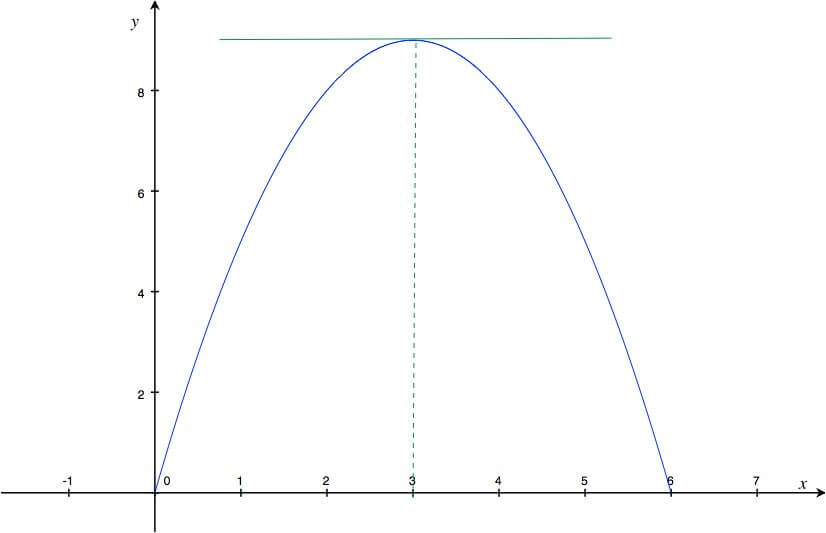
Find the value(s) of
We're looking for a value of
Now we can compute
The tangent line at the point

[ Hint: Use the Mean Value Theorem.]
The problem gives us the value of
First, note that since f(x) is differentiable for all x, it must be continuous for all x, and so the Mean Value Theorem (MVT) applies.
The problems says to use the MVT, so let's start there, and consider an interval
Prove the following statements:
[Hint: Consider the function
Whew, done! This "proof problem" is a good example of a question where we can't immediately see how it's going to turn out when we begin. Instead, you just have to dive in and start, and then try different things to keep moving forward, with the hope you'll land in the right place at the end. In this case, we had to just invoke that
Show that
(I) Show that the function has at least one root. We'll use the Intermediate Value Theorem for this part and show there exists some value
(II) We'll then use Rolle's Theorem to show, by contradiction, that
Those two facts together mean that
(I) Let's first show that the function has one real root.
First note that
(II) A proof by contradiction has three key steps:
1. Assume the opposite of what you want to prove.
2. Use that assumption to develop a new condition.
3. Show that the new condition contradicts your original assumption. Therefore your original assumption must be wrong, and so you've proved what you were originally after.
We'll proceed using those steps:
1. Let's assume that
2. Rolle's Theorem applies to
3. Let's compute
Hence we have shown that (I)
(I) show that the function has at least one root, and then
(II) use Rolle's Theorem and proof by contradiction to show that it does not have two or more roots.
(I) To show that
Since
(II) We again use proof by contradiction, following the same three steps as we did in part (a):
1. Assume the opposite of what you want to prove.
2. Use that assumption to develop a new condition.
3. Show that the new condition contradicts your original assumption. Therefore your original assumption must be wrong, and so you've proved what you were originally after.
We'll proceed using those steps:
1. Let's assume that
2. Rolle's Theorem applies to
3. Let's compute
Hence we have shown that (I)
Please let us know on the Forum:
- What questions do you have about the solutions above?
- Which ones are giving you the most trouble?
- What other Mean Value Theorem problems are you trying to work through for your class?
How helpful was this page?
Our goal is to provide the best content we can, for free to any student looking to learn well, and your feedback helps us improve.