C.3 Chain Rule - Deeper Work
You can see how the Chain Rule is chaining together the pieces here: the first line applies the Chain Rule to the outer function
If that seems abstract, let's make it concrete by finding the derivative of this function.
EXAMPLE 1: Applying the Chain Rule to
Differentiate
Solution.
We'll once again solve this two ways, first formally, and then informally the way you would probably quickly reason through, essentially just writing down the answer as you go.
Solution 1 (more formal).
We have the outside function
Their derivatives are
Then applying the Chain Rule gives
While the final line shows the answer in its simplified form, we suggest focusing on the preceding line (also with a green checkmark) since — again with practice — you can see how the Chain Rule has been applied to reach this result, starting with the outer function and then working your way inward. The following 'informal reasoning' solution makes this even more apparent.
Solution 2 (less formal, the way you're likely to come to reason quickly).
The overall function isStudents often request "harder examples," so let's find the derivative of a function comprised of 6(!) functions. You can step through finding the derivative of each component piece, but really we hope that — with practice, at least — you'll be able to start with the outside function and work your way inward, and write this answer down in one line. Indeed, we're putting the answer right at the top, so you can imagine doing just that, simply immediately writing down the answer, going term-by-term as you work your way further and further inside the nests of the function.
Example 2: Chain Rule applied to
Show that the derivative of
Solution.
Let's first show a picture of the chain that is this compound function. You probably wouldn't ever create this for yourself, but it's helpful for us to visualize together as we go step-by-step.
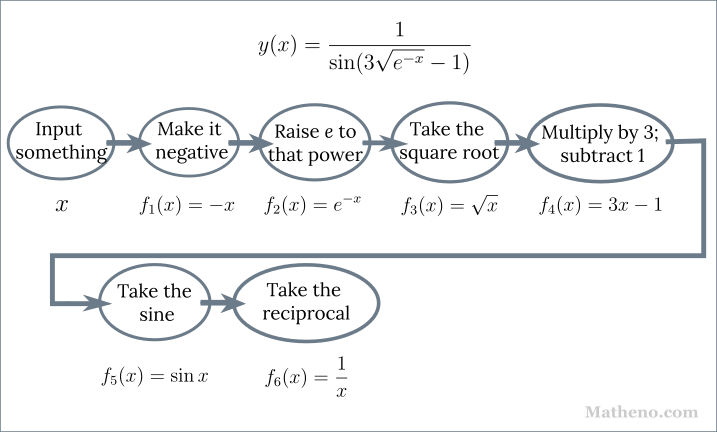
When presented with a more complicated function like y, we find it easier to rewrite reciprocals and roots in terms of negative and rational powers:
This makes it easier to see where we need to use power rule, and gives us more of a visual cue for when we hit a new interior function.
Let's summarize our answer, showing how each term arose:
If you wrote your answer like we did at the top of this Example (repeated here, with the added labels like
Furthermore, your grader is probably scanning for a line like this (without the labels), which clearly shows how you applied the Chain Rule to every inside function. If you got to this point, your Calculus is perfect.

Now here's a warning: most people, including us, are likely to introduce an algebraic error if they work to simplify — especially when rushing on an exam. So check with your teacher about what an acceptable "final form" is for your answer. If you can box the result above and receive full credit, we strongly recommend doing so. (And again, celebrate your growing Calculus skills!)
For completeness, here is the same answer in simplified form:
FAQ: When do I STOP applying the Chain Rule?
A student, Kiran, says:
"Now that I'm thinking about taking derivatives more layers down in the function, earlier why didn't we do
Great question! Kiran is certainly right that he's gone a step too far in taking that last derivative. If when using the Chain Rule you suddenly find yourself taking the derivative of a constant and the whole thing goes to zero, like Kiran's example, then you've also gone a step too far.
The reason is that the innermost function in
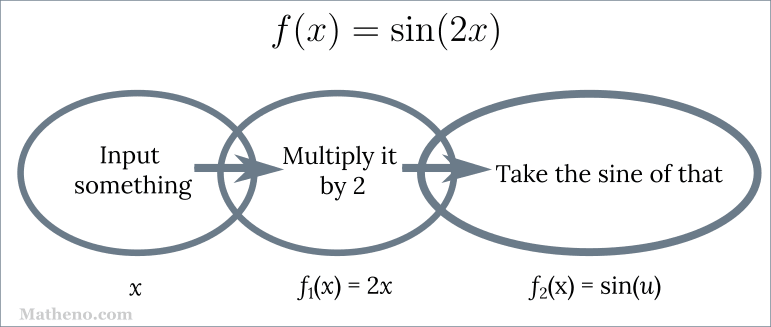
Creating this image (in our heads, if nothing else) shows where the calculation above went wrong: there is no inner function that is
(We love that Kiran is thinking all of this through!)
And now, time to practice applying the Chain Rule to more complex functions!
This problem requires using the Chain Rule twice.
Differentiate
Solution 1 (quick, the way most people reason).
Think something like: The overall function is
The outermost function is thus
Hence we first write
Solution 2 (more formal).
Although it's tedious to write out each separate function, let's use an extension of the first form of the Chain rule above, now applied to
Then
This problem requires using the Chain Rule twice.
Differentiate
Solution 1 (quick, the way most people reason).
Think something like:
The overall function is
The outermost function is thus
Next, the first inside function is
Solution 2 (more formal).
Although it's tedious to write out each separate function, let's use an extension of the first form of the Chain rule above, now applied to
Then
This problem requires using the Chain Rule three times.
DifferentiateHint: Recall that
We won't write out all of the tedious substitutions, and instead reason the way you'll need to become comfortable with:
The outermost function is
On the next and final screen in this Section on the Chain Rule, we'll use the rule to develop some further derivatives and facts that are useful to have in mind as we proceed. Of course that work will give you yet more practice at using the rule, too.
What questions do you have about what's on this screen, or other derivative problems you're working on? Please post on the Forum and let us know!
How helpful was this page?
Our goal is to provide the best content we can, for free to any student looking to learn well, and your feedback helps us improve.