B.1 The Product Rule
Let's now develop and practice using "The Product Rule," which we routinely need to find the derivative of the product of two differentiable functions,
The goal of this screen is to develop and provide lots of practice using a simple rule to compute the derivative of the product of two such differentiable functions,
A naive approach that does not work
Let's think through a super-quick example you can do in your head to illustrate a crucial point: Consider the function
If you're like most people who first encounter this question, you would find the derivative of each function individually and then simply multiply them together. We are going to spoil this naive thought immediately and say that this approach is incorrect:
Let's apply the naive reasoning to
Do not simply multiply the two derivatives together
That is, since the naive approach does not return what we know is the correct answer of
Instead, the derivative of the product of two functions is a little (only a little!) more complicated.
Developing the Product Rule
Let's ground our work here in what the derivative of this product of functions tells us: We're finding the rate at which the product
To develop the correct Product Rule, we return — as always — to the Definition of the Derivative, now applied to the product of two functions,
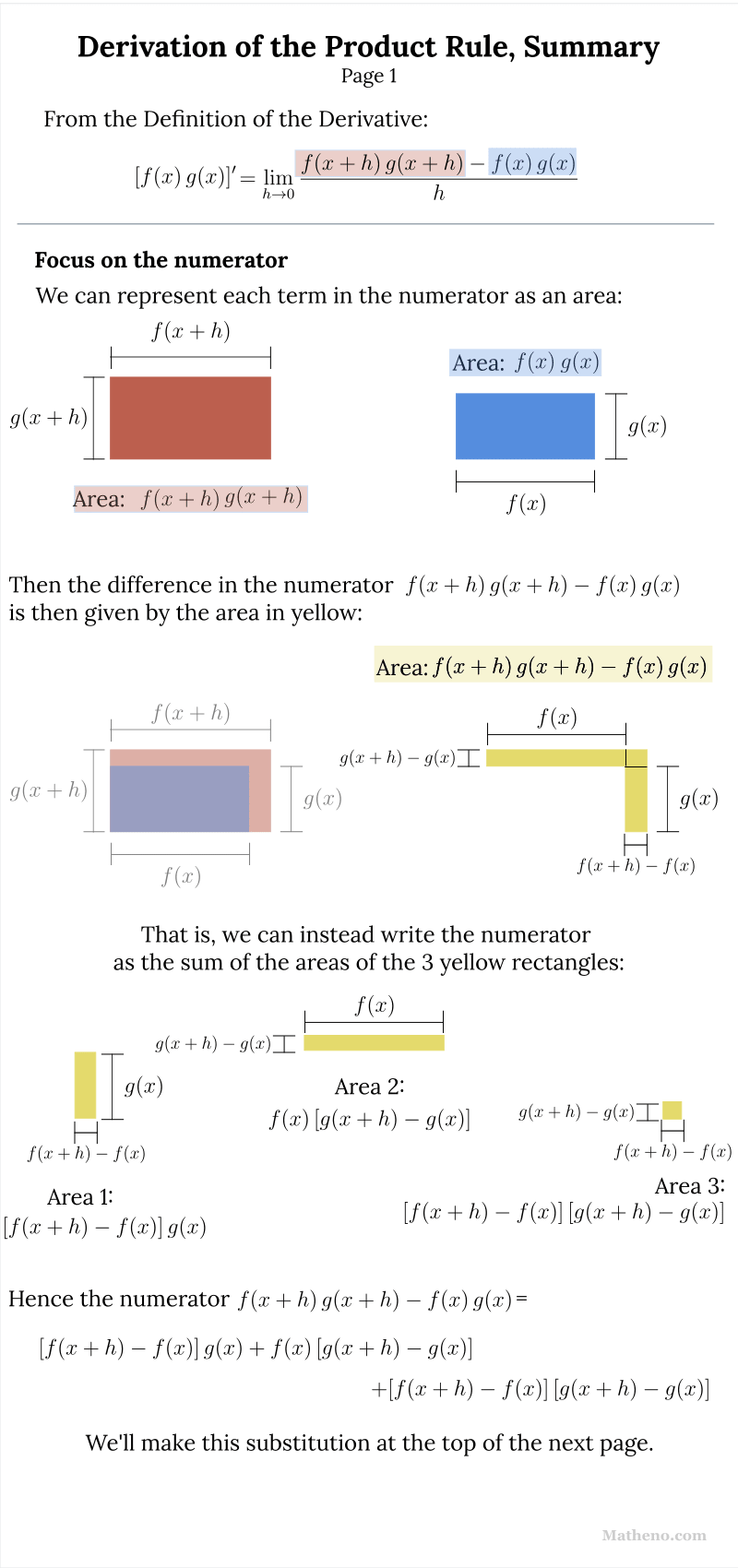
Looking at the expression, it's not immediately clear what to do with the limit and hence how to proceed. But the area model will help, since we can use it to write this initial expression in a way that includes the the terms
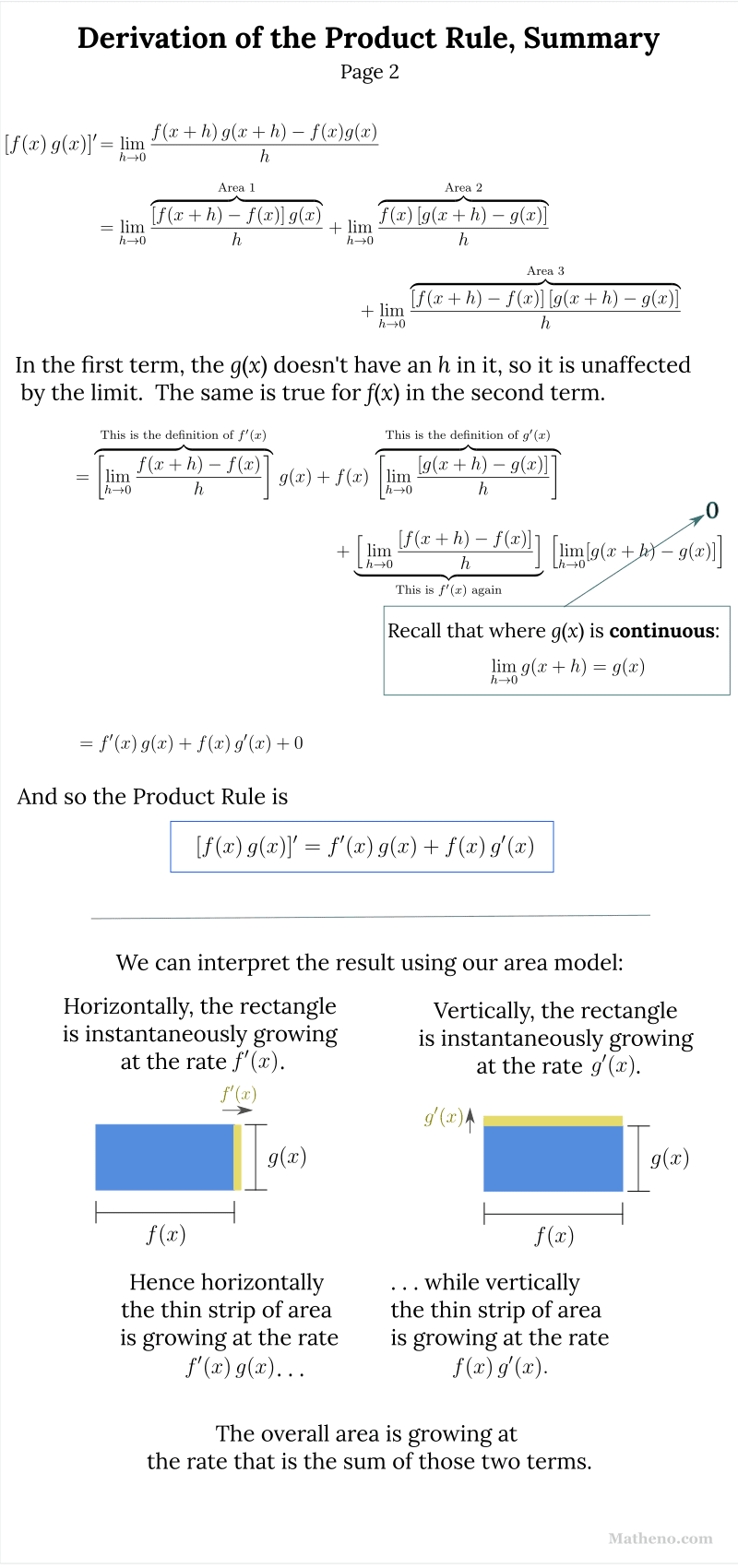
Once those terms are in place, when we take the limit as
As the derivation in the animation shows (and as summarized in images you can view and download a bit further down on the screen), the Product Rule for Derivatives is
PRODUCT RULE
In prime notation:
And in Leibnitz notation:
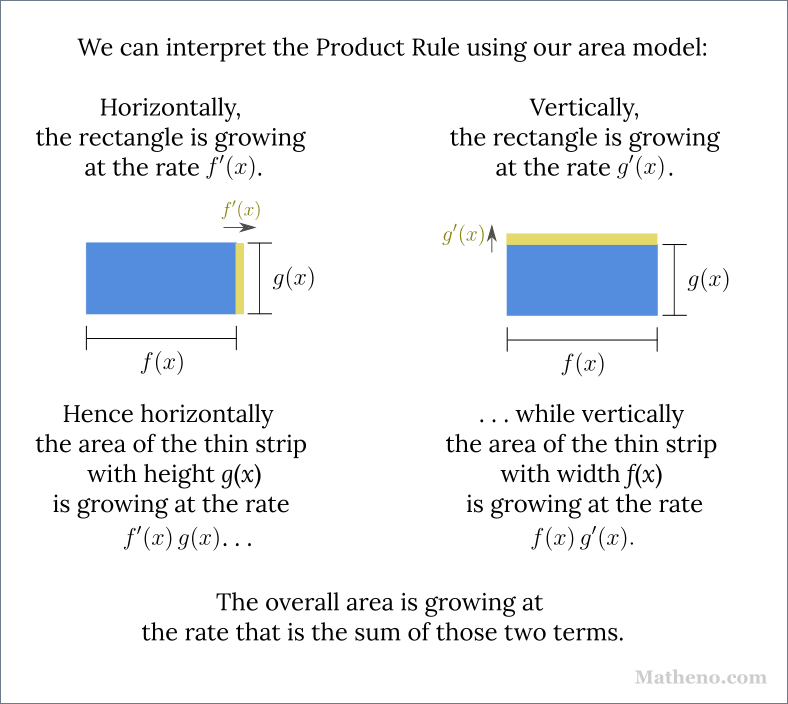
Crucially, using our area model we can make sense of this rule as shown in the following figure:
If you'd like to see a different approach to deriving the Product Rule, open this box. We'll rely on the "trick" used in this derivation on the next screen when we develop the Quotient Rule.
Practice using the Product Rule
Most students find that the Product Rule becomes automatic and routine after you use it a fair number of times — and you will be using it often in the work to come. We'll of course let you practice below, and you should expect similar problems on both your midterm and final exams.
Let's first consider a few Examples to show how it works in practice.
Derivative of
Find the derivative of
Solution.
To apply the Product Rule, we first need to identify the two functions being multiplied, and then find the derivative of each:
We can now apply the Product Rule:
Consider
(a) Use the Product Rule to find
(b) Instead, multiply out the two polynomials to make a single polynomial, and then find
Solution.
(a) First, we identify the two functions being multiplied, and take their derivatives. (Since the overall function is called
Then applying the Product Rule, we get
(b) We first multiply out the polynomials:
Then, using the Power Rule
This is happily the same result as we found in (a).
You can see that we can use using either method to find
Practice Problems
Time to practice! This new rule may take a little getting used to, so please practice until you feel more comfortable with it. We'll be using it a lot going forward, so the more you can make it part of your working toolkit now, the easier things will be later.We use the Product Rule applied to
Given that
Note:
| value of |
||||
|---|---|---|---|---|
| 2 | 0 | 1 | -5 | |
| 4 | 12 | -3 | ||
| 1 | 5 | 2 | -9 |
1. Find the slope of the tangent line
2. Find the y-value of the point of interest,
Step 1: Find the slope of the tangent line
We use the Product Rule and the values in the table to determine
We use the functions' values at
Then writing the equation for the line tangent to the curve
Let's consider some problems where we need to find the derivative of the product of 3 functions. The Product Rule extends as you might expect:
Product Rule for the Product of 3 Functions
Then
Then
 If
If The values of
 To determine
 To find that slope, we can use the two convenient points shown on the graph
 Similarly for the slope at
 Then the slope of
 If
If Inserting the values
1. Find the slope of the tangent line
2. Find the y-value of the point of interest,
Step 1: Find the slope of the tangent line
First we use the Product Rule to find the derivative of the function:
Then in Point-Slope form,
The Upshot
The Product Rule for finding the derivative of the product of two functions is In prime notation:
[ 𝑓 ( 𝑥 ) 𝑔 ( 𝑥 ) ] ′ = 𝑓 ′ ( 𝑥 ) 𝑔 ( 𝑥 ) + 𝑓 ( 𝑥 ) 𝑔 ′ ( 𝑥 ) = [ ( d e r i v a t i v e o f t h e f i r s t ) × ( t h e s e c o n d ) ] + [ ( t h e f i r s t ) × ( d e r i v a t i v e o f t h e s e c o n d ) ] And in Leibnitz notation:
𝑑 𝑑 𝑥 ( 𝑓 𝑔 ) = ( 𝑑 𝑑 𝑥 𝑓 ) 𝑔 + 𝑓 ( 𝑑 𝑑 𝑥 𝑔 ) = [ ( d e r i v a t i v e o f t h e f i r s t ) × ( t h e s e c o n d ) ] + [ ( t h e f i r s t ) × ( d e r i v a t i v e o f t h e s e c o n d ) ]
On the next screen, we'll develop the Quotient Rule, so we can easily find the derivative of the quotient of two functions.
For now, what do you think about the Product Rule? Weird? Difficult to use? Easy? Please post on the Forum and let the Community know your thoughts . . . and also ask any questions that you have, or help answer someone else's!
How helpful was this page?
Our goal is to provide the best content we can, for free to any student looking to learn well, and your feedback helps us improve.