Curve Sketching

This placeholder page contains free typical curve sketching problems, each with a detailed solution, for you to practice. Curve sketching problems tie together many of the skills you've been developing, so are a favorite of instructors to put on exams since they test many things at once. They thus serve as excellent exam preparation, so practice here, where you can make and correct any small errors without penalty – and be ready for your exam!

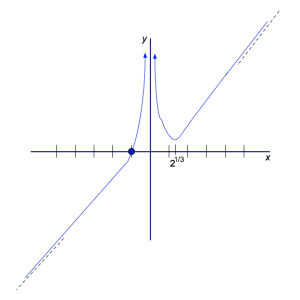
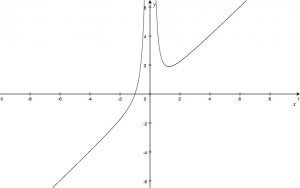
Practicce Problem #1: 𝑓(𝑥) =𝑑𝑓𝑟𝑎𝑐𝑥3+1𝑥2

Consider the function 𝑓(𝑥) =𝑑𝑓𝑟𝑎𝑐𝑥3+1𝑥2.

(a)
Is 𝑓(𝑥) even, odd, or neither?
(b)
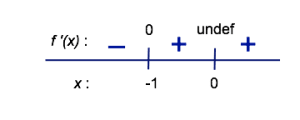
In which intervals is 𝑓(𝑥) concave up? concave down?
(c)
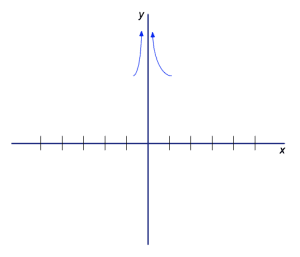
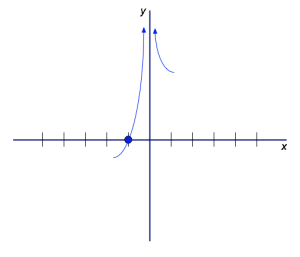
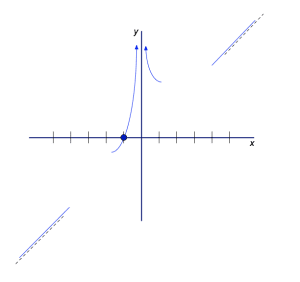
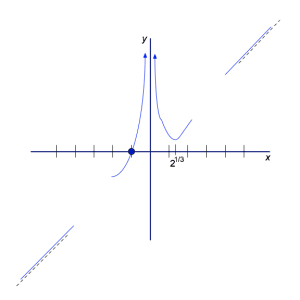
Sketch the curve 𝑦 =𝑓(𝑥).
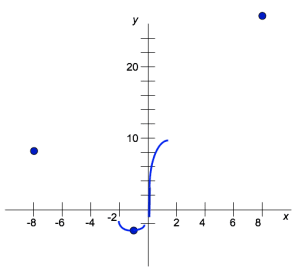
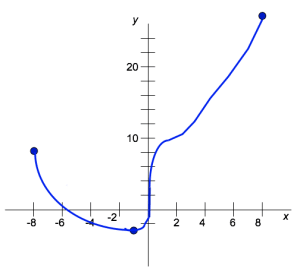
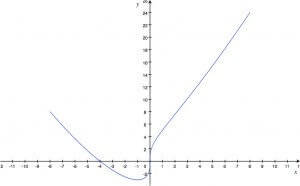
Practice Problem #2: 𝑓(𝑥) =𝑥4/3 +4𝑥1/3

Consider the function 𝑓(𝑥) =𝑥4/3 +4𝑥1/3 on the interval 8𝑙𝑒𝑥𝑙𝑒8.

(a)
Find the coordinates of all points at which the tangent to the curve is a horizontal line.
(b)
Find the coordinates of all points at which the tangent to the curve is a vertical line.
(c)
Find the coordinates of the points at which the absolute maximum and absolute minimum occur.
(d)
For what values of 𝑥 is the function concave down?
(e)
Sketch the curve 𝑦 =𝑓(𝑥).
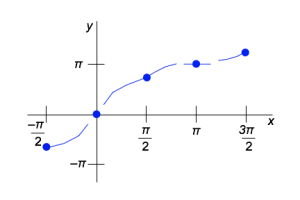
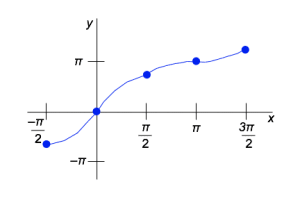
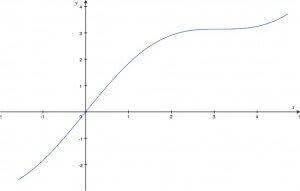
Practice Problem #3: 𝑦 =𝑥 +𝑠𝑖𝑛𝑥

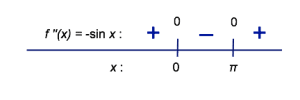
Consider the function defined by 𝑦 =𝑥 +𝑠𝑖𝑛𝑥 for all 𝑥 such that 𝑑𝑓𝑟𝑎𝑐𝑝𝑖2𝑙𝑒𝑥𝑙𝑒𝑑𝑓𝑟𝑎𝑐3𝑝𝑖2.
(a)
Find the coordinates of all maximum and minimum points on the given interval. Justify your answers.
(b)
Find the coordinates of all points of inflection on the given interval. Justify your answers.
(c)
Sketch the graph of the function.
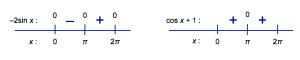
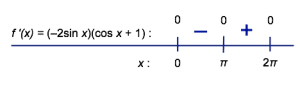
Practice Problem #4: 𝑓(𝑥) =𝑐𝑜𝑠2𝑥 +2𝑐𝑜𝑠𝑥

Consider the function 𝑓(𝑥) =𝑐𝑜𝑠2𝑥 +2𝑐𝑜𝑠𝑥 on the interval [0,2𝑝𝑖].

(a)
Find all values of 𝑥 in this at which 𝑓(𝑥) =0.
(b)
Find all values of 𝑥 in this period at which the function has a minimum. Justify your answer.
(c)
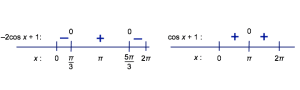
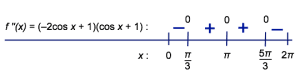
Over what intervals in this period is the curve concave up?
Practice Problem #5: 𝑓(𝑥) =𝑑𝑓𝑟𝑎𝑐1𝑥 +𝑙𝑛𝑥

Let 𝑓(𝑥) =𝑑𝑓𝑟𝑎𝑐1𝑥 +𝑙𝑛𝑥, defined only on the interval 𝑑𝑓𝑟𝑎𝑐1𝑒𝑙𝑒𝑥𝑙𝑒𝑒.

(a)
Determine the value of 𝑥 at which 𝑓 has its (i) absolute maximum and (ii) absolute minimum. Show your reasoning.
(b)
For what values of 𝑥 is the curve concave up?
(c)
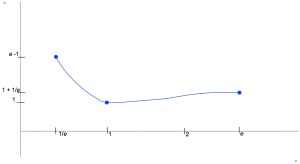
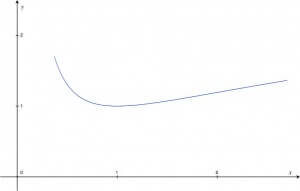
Sketch a graph of 𝑓(𝑥). (Do not use a graphing program; instead use the results above to inform your sketch.)

Note: These two questions don't actually ask you to sketch a function's curve, but they do rely heavily on the concepts and tools we've been practicing in this unit and so we're placing them here since they often appear on exams.

(We'll see another approach to this question in "Mean Value Theorem," but many students find this solution approach more intuitive and so easier to remember.)

Practice Problem #5: Show that ... has exactly one root

Note: These two questions don't actually ask you to sketch a function's curve, but they do rely heavily on the concepts and tools we've been practicing in this unit and so we're placing them here since they often appear on exams.

(We'll see another approach to this question in 'Mean Value Theorem,' but many students find this solution approach more intuitive and so easier to remember.)
(a)
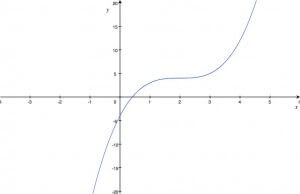
Show that 𝑓(𝑥) =𝑥3 6𝑥2 +12𝑥 4 has exactly one real root.
(b)
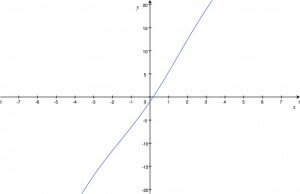
Show that 𝑔(𝑥) =6𝑥 cos𝑥 has exactly one real root.