Maxima & Minima
This placeholder page contains a summary of how to do max/min problems in Calculus, and free problems for you to practice, each with a complete solution immediately available. Let's jump right in!
PROBLEM SOLVING STRATEGY: Maxima & Minima
This is not a recipe for you simply to follow, but rather a series of steps to help guide your thinking that will often work well.
- Compute the function's derivative,
𝑓 ′ ( 𝑥 ) - Find all critical numbers c such that either:
- the derivative is zero:
𝑓 ′ ( 𝑐 ) = 0 - or the derivative
𝑓 ′ ( 𝑐 )
(If you are examining a closed interval (𝑎 ≤ 𝑥 ≤ 𝑏 - the derivative is zero:
- For each critical point c, check whether f is a local maximum or minimum or neither. Use either the First Derivative Test or the Second Derivative Test.
A. First Derivative Test:
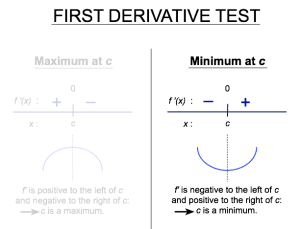
Check a convenient value that's less than c to see whether𝑓 ′ 𝑓 ′ - if the derivative switches from positive to negative, you've found a local maximum.
- if it switches from negative to positive, you've found a local minimum.
- if it doesn't switch, it is neither a maximum nor a minimum; it is simply a point with a horizontal tangent (if
𝑓 ′ ( 𝑐 ) = 0 𝑓 ′ ( 𝑐 )

B. Second Derivative Test:
Compute the function's second derivative,𝑓 ″ ( 𝑥 ) . 𝑓 ″ ( 𝑐 ) - if
𝑓 ″ ( 𝑐 ) 𝑐 - if it's positive (so the function is concave up there), then
𝑐

- If requested, compute the value(s) of
𝑓 ( 𝑐 ) 𝑦 - If the function has endpoints (
𝑎 ≤ 𝑥 ≤ 𝑏 𝑓 ( 𝑎 ) 𝑓 ( 𝑏 ) 𝑓 ( 𝑐 )
Of course the most important thing is to practice. Problem 1 steps you through the process to find the relative maximum and minimum of a function. Problem 2 then examines the same function, but now looks for the global maximum and minimum on an interval.
Consider the function




Find the
From Question 1, we already know the critical points are
To determine the absolute maximum and absolute minimum, we simply have to compute the values of
We thus conclude that, on the interval [0, 3];
Consider the function

Following the Problem Solving Strategy outlined above:
1. Compute the function's derivative,
2. Find all critical numbers
4, 5. Compute the values of
We now compare the value of
Hence the function on the interval [0.1, 2]:
For comparison, we've graphed the function below

We want to find the value of
To verify that
So

We need to find two unknowns,
(I) For
(II) Now that we know
For comparison, we've graphed the function with these values of

A particle moves along the x-axis so that its velocity at time

Please visit our Forum and tell us:
- What questions do you have about the solutions above?
- Which ones are giving you the most trouble?
- What other Max/Min problems are you trying to work through for your class?
If you let us know, we'll do our best to help!
How helpful was this page?
Our goal is to provide the best content we can, for free to any student looking to learn well, and your feedback helps us improve.