Optimization
This page contains free practice, typical optimization problems, each with a detailed solution. The only way to get this problem type down is by practicing, so practice here where you won't be penalized for getting stuck or making small errors. You are guaranteed to have an optimization problem on your upcoming exam, so the time to make all those typical errors is now!
We work through how to use our "Problem Solving Strategy: Optimization" step-by-step in our blog post How to Solve Optimization Problems in Calculus, one of our most popular posts.
PROBLEM SOLVING STRATEGY: Optimization
The strategy consists of two Big Stages. The first does not involve Calculus at all; the second is identical to what you did for max/min problems.
Stage I: Develop the function.
Your first job is to develop a function that represents the quantity you want to optimize. It can depend on only one variable. The steps:
- Draw a picture of the physical situation.
Also note any physical restrictions determined by the physical situation. - Write an equation that relates the quantity you want to optimize in terms of the relevant variables.
- If necessary, use other given information to rewrite your equation in terms of a single variable.
Stage II: Maximize or minimize the function.
You now have a standard max/min problem to solve.
- Take the derivative of your equation with respect to your single variable. Then find the critical points.
- Determine the maxima and minima as necessary.
Remember to check the endpoints if there are any. - Justify your maxima or minima either by reasoning about the physical situation, or with the first derivative test, or with the second derivative test.
- Finally, check to make sure you have answered the question as asked: Re-read the problem and verify that you are providing the value(s) requested: an x or y value; or coordinates; or a maximum area; or a shortest time; whatever was asked.
Minimize cost of materials for a soda can
 1. Draw a picture of the physical situation.
See the figure. We've called the radius of the cylinder r, and its height h.
2. Write an equation that relates the quantity you want to optimize in terms of the relevant variables.
We want to minimize the amount of metal we use, which is to say we want to minimize the area of the can. The can consists of a cylinder of surface area
The can's area A currently depends on two variables, r and h. In order to proceed, we must use other information we're given to rewrite the area in terms of just one of those variables. Let's choose r as that single variable. We must then eliminate the height h as a variable. To do so, we note that the can must hold volume V of liquid. Since the volume of a cylinder of radius r and height h is
 We've graphed the function (with
 Let's examine the second derivative. Above we found the first derivative:
Recall that we found above
The question asked us to specify the cylinder's dimensions, which we have provided.
What are the dimensions of the poster with the smallest total area?
Stage I: Develop the function. Your first job is to develop a function that represents the quantity you want to optimize. It can depend on only one variable. The steps:
 1. Draw a picture of the physical situation.
See the figure. We've called the width of the printed area x, and its length y. We can then write the printed area as
2. Write an equation that relates the quantity you want to optimize in terms of the relevant variables.
We see from the figure that the poster has total width
The poster's area
 We've graphed the function, a step you probably
wouldn't do yourself — but we want to emphasize that everything you've done so far is to
create a function that you're now going to minimize. One choice would be to closely examine the
graph to determine the value of
x that minimizes
A . . . but instead we're going to use the max/min techniques you learned recently!
Stage II: Maximize or minimize the function. You now have a standard max/min
problem to solve.
We've graphed the function, a step you probably
wouldn't do yourself — but we want to emphasize that everything you've done so far is to
create a function that you're now going to minimize. One choice would be to closely examine the
graph to determine the value of
x that minimizes
A . . . but instead we're going to use the max/min techniques you learned recently!
Stage II: Maximize or minimize the function. You now have a standard max/min
problem to solve.
4. Take the derivative of your equation with respect to your single variable. Then find the critical points.
Recall that we found above that
Let's use the second derivative test to verify that the critical point we've found represents a minimum. We found above that the first derivative is
7. Finally, check to make sure you have answered the question as asked: x or y values, or coordinates, or a maximum area, or a shortest time, or . . . .
Careful! We've found x and y for the poster's printed area, but the question asks for the dimensions of the overall poster. Those values are
Shortest time to row, then run, to a point on shore
 You are in a boat on a still lake,
near a straight section of shore. The nearest point to shore is 2 km away. You are aiming to get
back to your food and drink supplies, 4 km south of that nearest point. You can row at 5 km/hr, and
run at 8 km/hr. At what point
You are in a boat on a still lake,
near a straight section of shore. The nearest point to shore is 2 km away. You are aiming to get
back to your food and drink supplies, 4 km south of that nearest point. You can row at 5 km/hr, and
run at 8 km/hr. At what point  1. Draw a picture of the physical situation.
See the figure. We've called the distance from the point nearest on shore down to where will land the boat
2. Write an equation that relates the quantity you want to optimize in terms of the relevant variables.
We want to minimize the time it will take us to reach the supplies. Recall the fundamental relation
Or you could instead row straight to your supplies, which would take time
Let's use our usual approach to find a minimum time required if we put the point
By landing at point
Since our equation has only one variable, x, we skip step 3 of our strategy.
4. Take the derivative of your equation with respect to your single variable. Then find the critical points.
5. Determine the maxima and minima as necessary. Remember to check the endpoints if there are any.
6. Justify your maxima or minima either by reasoning about the physical situation, or with the first derivative test, or with the second derivative test.
Just for completeness, let's compute the time required when you land 1.6 km south of your current location:
7. Finally, check to make sure you have answered the question as asked:
The best location to land is a distance
Two boats sailing; when closest together?
 1. Draw a picture of the physical situation.
Once again, a good picture is key to proceeding correctly. Here we'll actually sketch two figures to represent the situation at noon, when the scenario begins, and one for some later, general time
The upper figure shows the situation at noon: Boat A is leaving the dock (shown as a brown square), traveling northward. Boat B is headed straight eastward toward the dock. At this instant, it is 40 km away, which we know since it will reach the dock 2 hours later (at 2:00 PM) and is traveling at 20 km/hr.
The lower figure shows the situation at later time
Since Boat B is traveling at 20 km/hr, it has traveled a distance
2. Write an equation that relates the quantity you want to optimize in terms of the relevant variables.
The distance
4. Take the derivative of your equation with respect to your single variable. Then find the critical points.
The minimum value of
Hence the critical point occurs for
5. Determine the maxima and minima as necessary. Remember to check the endpoints if there are any.
6. Justify your maxima or minima either by reasoning about the physical situation, or with the first derivative test, or with the second derivative test.
The second derivative of
7. Finally, check to make sure you have answered the question as asked:
We have found the time at which the boats are closest, as requested.
What dimensions minimize the cost of a garden fence?
Sam wants to build a garden fence to protect a rectangular 400 square-foot planting area. His next-door neighbor agrees to pay for half of the fence that borders her property; Sam will pay the rest of the cost. What are the dimensions of the planting area that will minimize Sam's cost to build the fence? (You may leave your answer as a square root; you don't have to find a decimal result.)
View/Hide Solution
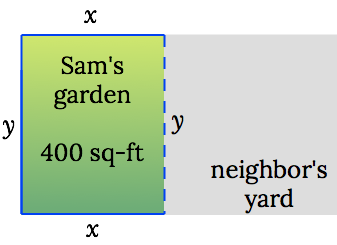
1. Draw a picture of the physical situation.
See the figure. We've called the width of the garden x (the top and bottom portions of the fence), and the length of the garden y (the left and right sides). Note also that the total area of Sam's garden must be
2. Write an equation that relates the quantity you want to optimize in terms of the relevant variables.
We want to minimize Sam's cost for building the fence, which is the same as minimizing the amount of fence that he's paying for. Let's call that cost C. Remember that Sam is only paying for half of the cost of the right side of the fence, since his neighbor is paying for that other half. Then
3. If necessary, use other given information to rewrite your equation in terms of a single variable.
The cost C currently depends on two variables, y and x. In order to proceed, we must use other information we're given to rewrite the area in terms of just one of those variables. Let's choose x as that single variable.
We must then eliminate y as a variable. To do so, recall that Sam's garden must have area
we can solve for y in terms of x:
Substituting this expression for y into our expression above for the cost C:
The expression for C is now a function of the single variable x, as required.
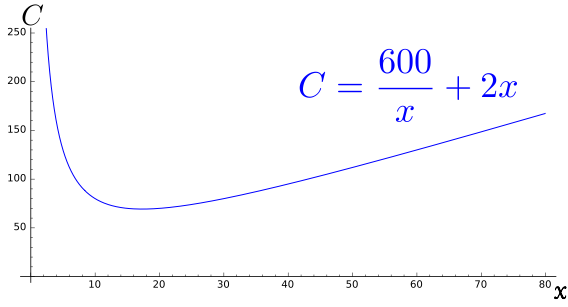
We've graphed the function, a step you probably wouldn't do yourself — but we want to emphasize that everything you've done so far is to create a function that you're now going to minimize.
4. Take the derivative of your equation with respect to your single variable. Then find the critical points.
The critical points occur when
Note that we choose the positive square root since the width x cannot be negative. Also note that we could have a critical point where
5. Justify your maxima or minima either by reasoning about the physical situation, or with the first derivative test, or with the second derivative test.
Let's examine the second derivative. Above we found the first derivative:
The second derivative is thus
Since
The minimum cost occurs when
6. Determine the maxima and minima as necessary. Remember to check the endpoints if there are any.
Recall that we found above that
Hence Sam's cost is minimized when the garden has
width
and
length
7. Finally, check to make sure you have answered the question as asked:
The question asked us to specify the garden's dimensions, which we have provided.
Rectangle inscribed in ellipse
 1. Draw a picture of the physical situation.
See the figure. We've marked the upper right corner of the rectangle with coordinates
2. Write an equation that relates the quantity you want to optimize in terms of the relevant variables.
We want to maximize the rectangle's area, given the constraint that its corners must lie on the ellipse.
3. If necessary, use other given information to rewrite your equation in terms of a single variable.
We choose to write the ellipse's area solely in terms of
The positive square root corresponds to the top half of the ellipse (positive values of
We can now write the rectangle's area as
4. Take the derivative of your equation with respect to your single variable. Then find the critical points.
5. Determine the maxima and minima as necessary. Remember to check the endpoints if there are any.
The critical points occur when (I)
(I)
(II)When
6. Justify your maxima or minima either by reasoning about the physical situation, or with the first derivative test, or with the second derivative test.
Since
Finally, check to make sure you have answered the question as asked:
Careful! The question asked for the maximum area that can be inscribed, and so to finish the problem we must provide that.
Rectangle with the greatest area is a square
 1. Draw a picture of the physical situation.
Many students don't know where to begin when faced with this question. As always, we start with a figure: we're trying to demonstrate something about a rectangle, so we draw a rectangle, with sides labeled
The rectangle has a given perimeter
2. Write an equation that relates the quantity you want to optimize in terms of the relevant variables.
We want to maximize the area of the rectangle,
We choose to write the area solely in terms of the width
Thus we can write the area as
3. Take the derivative of your equation with respect to your single variable. Then find the critical points.
Remember that the perimeter
5. Determine the maxima and minima as necessary. Remember to check the endpoints if there are any.
6. Justify your maxima or minima either by reasoning about the physical situation, or with the first derivative test, or with the second derivative test.
Since
When
Hence the maximum area of the rectangle occurs when the rectangle's width and length are equal to each other, and to one-quarter the perimeter of the total perimeter:
Shortest ladder required to reach a house over a wall
 A wall 10 feet high is six feet
from a house. Find the length of the shortest ladder that will reach the house while leaning against
the fence.
A wall 10 feet high is six feet
from a house. Find the length of the shortest ladder that will reach the house while leaning against
the fence.
[ Hint: The math works out more easily if you call
 1. Draw a picture of the physical situation.
See the figure. As suggested by the hint, we've called the distance from the ladder's base to the wall
2. Write an equation that relates the quantity you want to optimize in terms of the relevant variables.
The ladder's length
3. If necessary, use other given information to rewrite your equation in terms of a single variable.
We choose to write the ladder's length solely in terms of the variable
4. Take the derivative of your equation with respect to your single variable. Then find the critical points.
The minimum value of
The minima occur when
5. Determine the maxima and minima as necessary. Remember to check the endpoints if there are any.
6. Justify your maxima or minima either by reasoning about the physical situation, or with the first derivative test, or with the second derivative test.
7. Finally, check to make sure you have answered the question as asked:
Careful! The question asked for the ladder's shortest length, so to finish we must compute that.
When
Rectangular & square enclosures

Triangle bounded by axes and curve
Note: You may use a calculator to compute the areas.
 1. Draw a picture of the physical situation.
See the upper figure. We had trouble envisioning this at first, but drawing the picture while working through the description makes it clear: One vertex is on the origin, so mark that spot first. One of the perpendicular sides is along the
Finally, the third side, the hypotenuse, must then go from that point back to the origin. See the lower figure.
2. Write an equation that relates the quantity you want to optimize in terms of the relevant variables.
The triangle has area
We choose to write the area solely in terms of the variable
4. Take the derivative of your equation with respect to your single variable. Then find the critical points.
The only critical point, when
5. Determine the maxima and minima as necessary. Remember to check the endpoints if there are any.
We now just need to check the critical point (
Hence the minimum area is 0.27 (when
7. Finally, check to make sure you have answered the question as asked:
The question asks for the minimum and maximum areas, which we have provided.
Please let us know on our Forum:
- What questions do you have about the solutions above?
- Which ones are giving you the most trouble?
- What other Optimization problems are you trying to work through for your class?
If you let us know, we'll do our best to help!
How helpful was this page?
Our goal is to provide the best content we can, for free to any student looking to learn well, and your feedback helps us improve.