On this screen we'll practice related rates problems, each with a complete solution immediately available. Learn our 4-step problem solving strategy to solve any problem, and practice it using the problems below so you'll be ready for your exam!
In the subsections below, we'll solve each problem step-by-step using the strategy outlined in the Problem Solving Strategy box below. Each subsection lets you practice a specific approach that's listed in Step 2.B of the Problem Solving Strategy:
Geometric fact. Typical problems: A circle's radius changes, a snowball melts, a rectangle's height and/or width changes.
Trig function. Typical problems: A searchlight rotates, a rocket takes off, a kite travels horizontally.
Similar triangles. Water fills a cone or trough, sand falls onto a conical pile, person walks away from a light pole that casts a shadow.
Pythagorean theorem. Typical problems: Cars/ships/joggers move along 90 degree paths, baseball players run along the diamond, boat is pulled toward a dock.
Be sure to practice some of each โ but if you need to focus your time, put it on similar triangles and the Pythagorean theorem since those problems appear most frequently.
Related Rates Problem Solving Strategy
PROBLEM SOLVING STRATEGY: Related Rates
We developed the general strategy we will use to solve these problems in our blog post 4 Steps to Solve Any Related Rates Problem. (Link will open in a new tab.) You might find it helpful to read that post before proceeding if you haven't already.
The following steps are not a recipe for you simply to follow, but rather a sequence to help guide your thinking and lead you to be able to solve each problem you encounter.
Draw a picture of the physical situation.
Write an equation that relates the quantities of interest.
Be sure to label as a variable any value that changes as the situation progresses; don't substitute a number for it yet. To develop your equation, you will probably use:
a simple geometric fact (like the relation between a sphere's volume and its radius, or the relation between the volume of a cylinder and its height); or
a trigonometric function (like tanโก๐ = opposite/adjacent); or
similar triangles; or
the Pythagorean theorem.
Take the derivative with respect to time of both sides of your equation. Remember the chain rule.
Solve for the quantity you're after.
Related Rates: Given an Equation, Find the Rate
Before we dive into typical related rates questions, let's actually examine one that sometimes shows up in beginning homework problems where an equation is simply given to you and so you essentially skip the first two steps of our process and jump right to Step 3.
Practice Problem: Given an equation, find the rate
If ๐ฆ=๐ฅ3+2๐ฅ and ๐๐ฅ๐๐ก=6, find ๐๐ฆ๐๐ก when ๐ฅ=5.
View/Hide Solution
We can still use our Related Rates Problem Solving Strategy above. Instead of starting at Step 1, we simply start at Step 3:
3. Take the derivative with respect to time of both sides of your equation. Remember the chain rule.
Are you wondering why ๐๐ฆ๐๐ก and ๐๐ฅ๐๐ก appear? The answer is the Chain Rule.
While the derivative of ๐ฅ3 with respect to x is ๐๐๐ฅ๐ฅ3=3๐ฅ2, the derivative of ๐ฅ3 with respect to time t is ๐๐๐ก๐ฅ3=3๐ฅ2๐๐ฅ๐๐ก. (Recall that that rate is ๐๐ฅ๐๐ก=6 in this problem.)
The Chain rule term would be clearer if we explicitly wrote the time-dependence of both y and x. Remember that both quantities change as time passes, and so they are functions of time t. We could have captured this time-dependence explicitly by writing our original relation as ๐ฆ(๐ก)=[๐ฅ(๐ก)]3+2[๐ฅ(๐ก)] to remind ourselves that both y and x are functions of time t. Then when we take the derivative, ๐๐๐ก๐ฆ(๐ก)=๐๐๐ก[๐ฅ(๐ก)]3+2๐๐๐ก[๐ฅ(๐ก)] Now the term ๐๐๐ก๐ฆ(๐ก) is the rate ๐๐ฆ(๐ก)๐๐ก.
And looking at the last term, ๐๐๐ก๐ฅ(๐ก) is the rate ๐๐ฅ(๐ก)๐๐ก.
The derivative ๐๐๐ก[(stuff)]3=3(stuff)2โ ๐๐๐ก(stuff), where the extra term at the end is due to the Chain rule. Here (stuff)=๐ฅ(๐ก), so we have ๐๐๐ก[๐ฅ(๐ก)]3=3[๐ฅ(๐ก)]2๐๐ฅ(๐ก)๐๐ก.
Most people find that writing the explicit time-dependence ๐ฆ(๐ก) and x(t) annoying, and so just write y and x instead. Regardless, you must remember that both y and x depend on t, and so when you take the derivative with respect to time the Chain Rule applies and you have the ๐๐ฆ๐๐ก and ๐๐ฅ๐๐ก terms.
4. Solve for the quantity you're after.
We want to find ๐๐ฆ๐๐ก when ๐ฅ=5. Recall that the problem told us that ๐๐ฅ๐๐ก=6.๐๐ฆ๐๐ก=3๐ฅ2๐๐ฅ๐๐ก+2๐๐ฅ๐๐ก=3(5)2(6)+2(6)=3(25)(6)+12=462โ
Related Rates: Using a Simple Geometric Fact
Many related rates problems make use of a simple geometric fact. For example,
the area of a circle is ๐ด=๐๐2
the volume of a sphere is ๐=43๐๐3
the area of a rectangle is ๐ด=๐๐ค
and so forth.
The following problems illustrate.
As a snowball melts, its area decreases at a given rate. How fast does its radius change? (Video solution)
Practice Problem: Spherical snowball melts at constant ๐๐ด๐๐ก, radius decreases
A spherical snowball melts symmetrically such that it is always a sphere. Its surface area decreases at the rate of ๐ in2/min. How fast is its radius changing at the instant when ๐=2 inches?
View/Hide Solution
[Scroll down for text-based (non-video) version of the solution.]
Let's unpack the question statement:
We're told that the snowball's area A is changing at the rate of ๐๐ด๐๐ก=โ๐ in2/min. (We must insert the negative sign "by hand" since we are told that the snowball is melting, and hence its area is decreasing.)
As a result, its radius is changing, at the rate ๐๐๐๐ก, which is the quantity we're after.
The snowball always remains a sphere.
Toward the end of our solution, we'll need to remember that the problem is asking us about ๐๐๐๐ก at a particular instant, when ๐=2 inches.
We of course use our 4 steps to solve this related rates problem as outlined in the Problem Solving Strategy box above:
1. Draw a picture of the physical situation.
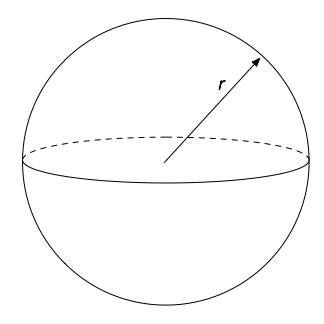
See the figure.
2. Write an equation that relates the quantities of interest.
B. To develop your equation, you will probably use. . . a simple geometric fact.
This is the hardest part of Related Rates problem for most students initially: you have to know how to develop the equation you need, how to pull that "out of thin air." By working through these problems you'll develop this skill. The key is to recognize which of the few sub-types of problem it is as described in the Problem Solving Strategy box above. In this problem, the diagram above reminds us that the snowball always remains a sphere, which is a Big Clue.
We need to develop a relationship between the rate we're given, ๐๐ด๐๐ก=โ๐ in2/min, and the rate we're after, ๐๐๐๐ก. We thus first need to write down a relationship between the sphere's area A and its radius r. But we know that relationship since it's a simple geometric fact for a sphere that you could look up if you don't know it: ๐ด=4๐๐2 That's it โ that's the key relationship we need to be able to proceed with our solution.
3. Take the derivative with respect to time of both sides of your equation. Remember the chain rule.
This video player starts at 6:08 for the relevant discussion; text discussion is below.
Are you wondering why that ๐๐๐๐ก appears? The answer is the Chain Rule.
While the derivative of ๐2 with respect to r is ๐๐๐๐2=2๐, the derivative of ๐2 with respect to time t is ๐๐๐ก๐2=2๐๐๐๐๐ก.
Remember that r is a function of time t: the radius changes as time passes and the snowball melts. We could have captured this time-dependence explicitly by writing our relation as ๐ด(๐ก)=4๐[๐(๐ก)]2 to remind ourselves that both A and r are functions of time t. Then when we take the derivative, ๐๐๐ก๐ด(๐ก)=๐๐๐ก[4๐[๐(๐ก)]2]๐๐ด(๐ก)๐๐ก=4๐๐๐๐ก[[๐(๐ก)]2]=4๐[2๐(๐ก)][๐๐๐ก๐(๐ก)]=8๐๐(๐ก)[๐๐(๐ก)๐๐ก]
[Recall ๐๐ด๐๐ก=โ๐ in2/min in this problem, and we're looking for ๐๐๐๐ก.]
Most people find that writing the explicit time-dependence A(t) and r(t) annoying, and so just write A and r instead. Regardless, you must remember that r depends on t, and so when you take the derivative with respect to time the Chain Rule applies and you have the ๐๐๐๐ก term.
Now we just have to substitute values. Recall ๐๐ด๐๐ก=โ๐ in2/min, and the problem asks about when ๐=2 inches:
๐๐๐๐ก=18๐๐๐๐ด๐๐ก=18๐(2in)(โ๐in2min)=โ116in/minโ That's the answer. The negative value indicates that the radius is decreasing as the snowball melts, as we expect.

Caution: IF you are using a web-based homework system and the question asks,
At what rate does the radius decrease?
then the system may have already accounted for the negative sign and so to be correct you must enter a POSITIVE VALUE: 116inminโ
We can't guarantee how this problem was coded into your homework system, and so unfortunately can only advise that if you think your answer of a negative value is correct but the system is marking it as wrong, try entering it as a positive value. (Many students have thanked us for this suggestion!)
Snowball melts at constant rate of volume change, radius decreases
Practice Problem: Spherical snowball melts at constant ๐๐๐๐ก, radius decreases
A spherical snowball is melting at the rate of 2๐ cm3/hr. It melts
symmetrically such that it is always a sphere. How fast is its radius changing at the
instant ๐=10 cm?
Answer: โ1200cm/hr. [If you are using a web-based homework system, see the "Caution" at the end of this solution.]
Let's unpack the question statement:
We're told that the snowball's volume V is changing at the rate of ๐๐๐๐ก=โ2๐ cm3/hr. (We must insert the negative sign "by hand" since we are told that the snowball is melting, and hence its volume is decreasing.)
As a result, its radius is changing, at the rate ๐๐๐๐ก, which is the quantity we're after.
The snowball always remains a sphere.
Toward the end of our solution, we'll need to remember that the problem is asking us about ๐๐๐๐ก at a particular instant, when ๐=10 cm.
Now let's use our 4-step Problem Solving Strategy as outlined above: 1. Draw a picture of the physical situation.
See the figure. 2. Write an equation that relates the quantities of interest. B. To develop your equation, you will probably use. . . a simple geometric fact.
In this problem we're given the value for ๐๐๐๐ก, and we're after the value of ๐๐๐๐ก. Hence we need to start with an expression that relates V to r. Since the snowball is a sphere, we know that relationship: ๐=43๐๐33. Take the derivative with respect to time of both sides of your equation. Remember the chain rule. ๐๐๐ก๐=๐๐๐ก(43๐๐3)๐๐๐๐ก=43๐๐๐๐ก(๐3)=43๐(3๐2๐๐๐๐ก)=4๐๐2๐๐๐๐ก
Are you wondering why that ๐๐๐๐ก appears? The answer is the Chain Rule.
While the derivative of ๐3 with respect to r is ๐๐๐๐3=3๐2, the derivative of ๐3 with respect to time t is ๐๐๐ก๐3=3๐2๐๐๐๐ก.
Remember that r is a function of time t: the radius changes as time passes and the snowball melts. We could have captured this time-dependence explicitly by writing our relation as
๐(๐ก)=43๐[๐(๐ก)]3
to remind ourselves that both V and r are functions of time t. Then when we take the derivative,
๐๐๐ก๐(๐ก)=๐๐๐ก[43๐[๐(๐ก)]3]๐๐(๐ก)๐๐ก=43๐3[๐(๐ก)]2[๐๐๐ก๐(๐ก)]=4๐[๐(๐ก)]2[๐๐๐๐ก]
[Recall ๐๐๐๐ก=โ2๐ cm3/hr in this problem, and we're looking for ๐๐๐๐ก.]
Most people find that writing the explicit time-dependence V(t) and r(t) annoying, and so just write V and r instead. Regardless, you must remember that r depends on t, and so when you take the derivative with respect to time the Chain Rule applies and you have the ๐๐๐๐ก term.
4. Solve for the quantity you're after.
Solving the equation above for ๐๐๐๐ก:
๐๐๐๐ก=4๐๐2๐๐๐๐ก๐๐๐๐ก=14๐๐2๐๐๐๐ก
Now we just have to substitute values. Recall ๐๐๐๐ก=โ2๐ cm3/hr,
and the problem asks about when ๐=10 cm:
๐๐๐๐ก=14๐๐2๐๐๐๐ก=14๐(10)2(โ2๐)=โ1200cm/hrโ
The negative value indicates that the radius is decreasing as the snowball melts, as we expect.
Caution: IF you are using a web-based homework system and the question asks,
At what rate does the radius decrease?
then the system (probably) has already accounted for the negative sign and so to be correct you must enter a POSITIVE VALUE: 1200cmhrโ (Why "probably"? Because the truth is it depends on how the question got coded into the system, and problem-writers often aren't consistent here. It's annoying.)
Circle expands
Practice Problem: Circle expands
What is the radius of an expanding circle at a moment when the rate of change of
its area is numerically half as big as the rate of change of its radius?
Answer: 14๐
When a circle expands, obviously its area changes; the rate at which its area changes is ๐๐ด๐๐ก. Its radius changes as well, at the rate ๐๐๐๐ก. Those two quantities are related, and that recognition is the crux of this problem. 1. Draw a picture of the physical situation.
See the figure. 2. Write an equation that relates the quantities of interest.
B. To develop your equation, you will probably use . . . a simple geometric fact.
Because we ultimately need a relation between ๐๐ด๐๐ก and ๐๐๐๐ก, we start with a relation between A and r. Fortunately, that's a particularly well-known relation: ๐ด=๐๐23. Take the derivative with respect to time of both sides of your equation. Remember the chain rule. ๐๐๐ก(๐ด)=๐๐๐ก(๐๐2)๐๐ด๐๐ก=2๐๐๐๐๐๐ก4. Solve for the quantity you're after.
The problem is asking us to find r at the instant when ๐๐ด๐๐ก=12๐๐๐๐ก, or when (๐๐ด๐๐ก)(๐๐๐๐ก)=12.
Starting from the preceding equation: ๐๐ด๐๐ก=2๐๐๐๐๐๐ก๐=12๐(๐๐ด๐๐ก)(๐๐๐๐ก)=12๐(12)=14๐โ
Rectangle, area increases as sides change
Practice Problem: Rectangle, find ๐๐ด๐๐ก given ๐๐๐๐ก and ๐๐ค๐๐ก
The length of a rectangle is increasing at the rate of 8 cm/s, and its width is
increasing at the rate of 5 cm/s. Consider the moment when its length is 3 cm and its
width is 4 cm. How fast is the area of the rectangle increasing?
Answer: ๐๐ด๐๐ก=47cm2s
Let's first unpack this question:
We're given that the rectangle's length is changing at the rate ๐๐๐๐ก=8 cm/s, and its width is changing at the rate ๐๐ค๐๐ก=5 cm/s. We're looking for ๐๐ด๐๐ก at the particular instant specified in the problem. 1. Draw a picture of the physical situation.
See the figure. 2. Write an equation that relates the quantities of interest. A. Be sure to label as a variable any value that changes as the situation progresses; don't substitute a number for it yet.
The rectangle's width and the length are both changing, so we'll leave them each as a variable. B. To develop your equation, you will probably use . . .a simple geometric fact.
We're looking for ๐๐ด๐๐ก given values for both ๐๐๐๐ก and ๐๐ค๐๐ก. That suggests we want to start with a relationship among the rectangle's area A and its length l and width w. Fortunately, that's one we immediately know: ๐ด=๐๐ค3. Take the derivative with respect to time of both sides of your equation. Remember the chain rule.
Both ๐ค and ๐ are changing with time, and so when we take the derivative we must use the Product Rule and include both ๐๐ค๐๐ก and ๐๐๐๐ก terms: ๐๐๐ก๐ด=๐๐๐ก(๐๐ค)๐๐ด๐๐ก=๐๐๐๐ก๐ค+๐๐๐ค๐๐ก4. Solve for the quantity you're after.
We want ๐๐ด๐๐ก at the moment when ๐=3 cm and ๐ค=4 cm. Furthermore, recall that the problem tells us ๐๐๐๐ก=8 cm/s, and its width is changing at the rate ๐๐ค๐๐ก=5 cm/s.
Hence
๐๐ด๐๐ก=๐๐๐๐ก๐ค+๐๐๐ค๐๐ก=(8cms)(4cm)+(3cm)(5cms)=32cm2s+15cm2s=47cm2sโ
Rectangle maintains constant area as its length increases
Practice Problem: Rectangle, constant area, length increases
A rectangle has constant area 500 square centimeters. Its length is increasing at the rate of 8 centimeters per second. What is its width at the moment the width is decreasing at the rate of 1 centimeter per second?
Answer: ๐ค=โ5008cm
This rectangle has constant area; you might imagine it as a flat piece of rubber that has constant area. As you stretch it out in one direction, it must shrink in the other to compensate. The faster you stretch it out, the faster its width must decrease to keep the area constant.
The problem tells us that the length is changing at the constant rate ๐๐๐๐ก=8 cm/s, a positive value since the length is increasing with time. We're after something about when the rate that the width changes, ๐๐ค๐๐ก , has a certain value (-1 cm/s). So we need to relate the width w to the length l at every moment. Fortunately we can do that easily since the area remains constant.
1. Draw a picture of the physical situation.
See the figure. 2. Write an equation that relates the quantities of interest. A. Be sure to label as a variable any value that changes as the situation progresses; don't substitute a number for it yet.
The rectangle's width and the length are both changing, so we'll leave them each as a variable. B. To develop your equation, you will probably use . . .a simple geometric fact.
Here we use the relation between the area of a rectangle and its width and length. Remember that the problem says that the rectangle's area stays constant at 500 cm2: ๐ด=500=๐ค๐3. Take the derivative with respect to time of both sides of your equation. Remember the chain rule.
Both ๐ค and ๐ are changing with time, and so when we take the derivative we must include ๐๐ค๐๐ก and ๐๐๐๐ก terms: ๐๐๐ก(500)=๐๐๐ก(๐ค๐)0=๐๐ค๐๐ก๐+๐ค๐๐๐๐ก4. Solve for the quantity you're after.
We want to find ๐ค at the instant ๐๐ค๐๐ก=โ1 cm/s. (Note that we must insert that negative sign "by hand" since the problem states that the width is decreasing.) We also know from the problem statement that ๐๐๐๐ก=8 cm/s (a positive value since the length is increasing with time).
Looking at the preceding equation, we see that we currently have two unknowns, ๐ and ๐ค. Since we're looking for ๐ค, let's eliminate ๐ by noting that the rectangle has constant area: ๐ด=500=๐๐ค. Hence ๐=500๐ค.
Then from the preceding equation:
0=๐๐ค๐๐ก๐+๐ค๐๐๐๐ก0=๐๐ค๐๐ก500๐ค+๐ค๐๐๐๐ก๐ค๐๐๐๐ก=โ500๐ค๐๐ค๐๐ก๐ค2=โ500(๐๐ค๐๐ก)(๐๐๐๐ก)
Recall ๐๐ค๐๐ก=โ1 cm/s and ๐๐๐๐ก=8 cm/s: ๐ค2=โ(500)(โ1)8=5008๐ค=โ5008cmโ
Square's sides grow, increasing both its perimeter and area
Practice Problem: Square, sides grow
A square has side-length x. Each side increases at the rate of 0.5 meters each second.
(a)
Find the rate at which the square's perimeter is increasing.
(b)
Find the rate at which the square's area increasing at the moment the area is 25m2.
(a)2.0ms
(b)5.0m2s
1. Draw a picture of the physical situation.
See the figure. We've labeled the length of each side of the square x. Recall that each side increases at the rate ๐๐ฅ๐๐ก=0.5ms. We'll use that value at the end of our solution.
2. Write an equation that relates the quantities of interest. A. Be sure to label as a variable any value that changes as the situation progresses; don't substitute a number for it yet.
The square's side-length changes as the situation progresses, so we're calling that the variable x. B. To develop your equation, you will probably use . . . a simple geometric fact.
In this problem, we're given the value for ๐๐ฅ๐๐ก, and we're looking for the value of ๐๐๐๐ก, where P is the square's perimeter. Hence we need to start with an expression that relates P to x. Since the object is a square, we know that relationship:
๐=4๐ฅ
That's it. That's the key relationship that will allow us to complete the solution.
3. Take the derivative with respect to time of both sides of your equation. Remember the chain rule. ๐๐๐ก๐=๐๐๐ก(4๐ฅ)๐๐๐๐ก=4๐๐ฅ๐๐ก
Are you wondering why ๐๐ฅ๐๐ก appears? The answer is the Chain Rule.
While the derivative of 4๐ฅ with respect to x is
๐๐๐ฅ4๐ฅ=4,
the derivative of 4๐ฅ with respect to time t is
๐๐๐ก4๐ฅ=4๐๐๐ก๐ฅ=4๐๐ฅ๐๐ก.
(Recall that that rate is ๐๐ฅ๐๐ก=0.5ms in this problem.)
Remember that x is a function of time t: the side-length xchanges as time passes. We could have captured this time-dependence explicitly by writing our relation as
๐(๐ก)=4๐ฅ(๐ก)
to remind ourselves that both P and x are functions of time t. Then when we take the derivative,
๐๐๐ก๐(๐ก)=๐๐๐ก[4๐ฅ(๐ก)]๐๐(๐ก)๐๐ก=4๐๐๐ก[๐ฅ(๐ก)]=4๐๐ฅ(๐ก)๐๐ก
[Recall ๐๐ฅ(๐ก)๐๐ก=.5ms, and we're looking for ๐๐(๐ก)๐๐ก.]
Most people find that writing the explicit time-dependence ๐(๐ก) and x(t) annoying, and so just write P and x instead. Regardless, you must remember that both P and x depend on t, and so when you take the derivative with respect to time the Chain Rule applies and you have the ๐๐ฅ๐๐ก term.
4. Solve for the quantity you're after.
This step is straightforward in this problem. We have ๐๐ฅ๐๐ก=0.5ms, so
๐๐๐๐ก=4๐๐ฅ๐๐ก=4(0.5ms)=2.0msโ
This result makes sense conceptually: the square has four sides, each of which is growing at the rate of 0.5ms. Hence the perimeter grows at the rate ๐๐๐๐ก=4(0.5ms)=2.0ms.
1. Draw a picture of the physical situation.
See the figure. We've labeled the length of each side of the square x. Recall that each side increases at the rate ๐๐ฅ๐๐ก=0.5ms, and we're interested in the moment when ๐ด=25m2. We'll use these values at the end of our solution.
2. Write an equation that relates the quantities of interest. A. Be sure to label as a variable any value that changes as the situation progresses; don't substitute a number for it yet.
The square's side-length changes as the situation progresses, so we're calling that the variable x. B. To develop your equation, you will probably use . . . a simple geometric fact.
In this problem, we're given the value for ๐๐ฅ๐๐ก, and we're looking for the value of ๐๐ด๐๐ก, where A is the square's area. Hence we need to start with an expression that relates A to x. Since the object is a square, we know that relationship:
๐ด=๐ฅ2
That's it. That's the key relationship that will allow us to complete the solution.
3. Take the derivative with respect to time of both sides of your equation. Remember the chain rule. ๐๐๐ก๐ด=๐๐๐ก๐ฅ2๐๐ด๐๐ก=2๐ฅ๐๐ฅ๐๐ก
Are you wondering why ๐๐ฅ๐๐ก appears? The answer is the Chain Rule.
While the derivative of ๐ฅ2 with respect to x is
๐๐๐ฅ๐ฅ2=2๐ฅ,
the derivative of ๐ฅ2 with respect to time t is
๐๐๐ก๐ฅ2=2๐ฅ๐๐ฅ๐๐ก.
(Recall that that rate is ๐๐ฅ๐๐ก=0.5ms in this problem.)
Remember that x is a function of time t: the side-length xchanges as time passes. We could have captured this time-dependence explicitly by writing our relation as
๐ด(๐ก)=[๐ฅ(๐ก)]2
to remind ourselves that both A and x are functions of time t. Then when we take the derivative,
๐๐๐ก๐ด(๐ก)=๐๐๐ก[๐ฅ(๐ก)]2๐๐ด(๐ก)๐๐ก=2[๐ฅ(๐ก)]๐๐ฅ(๐ก)๐๐ก
[Recall ๐๐ฅ(๐ก)๐๐ก=0.5ms, and we're looking for ๐๐ด(๐ก)๐๐ก at the moment when ๐ด(๐ก)=25m2.]
Most people find that writing the explicit time-dependence ๐ด(๐ก) and x(t) annoying, and so just write A and x instead. Regardless, you must remember that both A and x depend on t, and so when you take the derivative with respect to time the Chain Rule applies and you have the ๐๐ฅ๐๐ก term.
4. Solve for the quantity you're after.
We know that
๐๐ด๐๐ก=2๐ฅ๐๐ฅ๐๐ก
and we know that ๐๐ฅ๐๐ก=0.5ms. We also know that we're interested in the moment when ๐ด=25m2; to complete our calculuation, we need to know the value of x at that moment.
Begin subproblem to find x at the moment of interest.
Since ๐ด=๐ฅ2, when ๐ด=25m2:๐ฅ2=25m2๐ฅ=5.0mEnd subproblem.
We can now complete our calculation:
๐๐ด๐๐ก=2๐ฅ๐๐ฅ๐๐ก=2(5.0m)(0.5ms)=5.0m2sโ
Cube's sides grow, increasing both its volume and surface area
Practice Problem: Cube, sides grow
A cube has side-length x. Each side increases at the rate of 0.05 m/s.
(a)
At what rate is its volume increasing at the moment when ๐ฅ=0.4 m?
(b)
At what rate is its surface area increasing at the moment when ๐ฅ=0.6 m?
(a)0.024m3s
(b)0.36m2s
1. Draw a picture of the physical situation.
See the figure. We've labeled the length of each side of the cube x. Recall that each side increases at the rate ๐๐ฅ๐๐ก=0.05ms, and we're interested in the moment when ๐ฅ=0.4 m. We'll use these values at the end of our solution.
2. Write an equation that relates the quantities of interest. A. Be sure to label as a variable any value that changes as the situation progresses; don't substitute a number for it yet.
The cube's side-length changes as the situation progresses, so we're calling that the variable x. B. To develop your equation, you will probably use . . . a simple geometric fact.
In this problem, we're given the value for ๐๐ฅ๐๐ก, and we're looking for the value of ๐๐๐๐ก. Hence we need to start with an expression that relates V to x. Since the object is a cube, we know that relationship:
๐=๐ฅ3
That's it. That's the key relationship that will allow us to complete the solution.
3. Take the derivative with respect to time of both sides of your equation. Remember the chain rule. ๐๐๐ก๐=๐๐๐ก๐ฅ3๐๐๐๐ก=3๐ฅ2๐๐ฅ๐๐ก
Are you wondering why ๐๐ฅ๐๐ก appears? The answer is the Chain Rule.
While the derivative of ๐ฅ3 with respect to x is
๐๐๐ฅ๐ฅ3=3๐ฅ2,
the derivative of ๐ฅ3 with respect to time t is
๐๐๐ก๐ฅ3=3๐ฅ2๐๐ฅ๐๐ก.
(Recall that that rate is ๐๐ฅ๐๐ก=0.05ms in this problem.)
Remember that x is a function of time t: the side-length xchanges as time passes. We could have captured this time-dependence explicitly by writing our relation as
๐(๐ก)=[๐ฅ(๐ก)]3
to remind ourselves that both V and x are functions of time t. Then when we take the derivative,
๐๐๐ก๐(๐ก)=๐๐๐ก[๐ฅ(๐ก)]3๐๐(๐ก)๐๐ก=3[๐ฅ(๐ก)]2๐๐ฅ๐๐ก
[Recall ๐๐ฅ(๐ก)๐๐ก=.05ms, and we're looking for ๐๐(๐ก)๐๐ก at the moment when ๐ฅ(๐ก)=0.4 m.]
Most people find that writing the explicit time-dependence ๐(๐ก) and x(t) annoying, and so just write V and x instead. Regardless, you must remember that both V and x depend on t, and so when you take the derivative with respect to time the Chain Rule applies and you have the ๐๐ฅ๐๐ก term.
4. Solve for the quantity you're after.
This is straightforward in this problem. We have ๐๐ฅ๐๐ก=0.05ms and are interested in the moment when ๐ฅ(๐ก)=0.4 m:
๐๐๐๐ก=3๐ฅ2๐๐ฅ๐๐ก=3(0.4m)2(0.05ms)=0.024m3sโ
1. Draw a picture of the physical situation.
See the figure. We've labeled the length of each side of the cube x. Recall that each side increases at the rate ๐๐ฅ๐๐ก=0.05ms, and we're interested in the moment when ๐ฅ=0.6 m. We'll use these values at the end of our solution.
2. Write an equation that relates the quantities of interest. A. Be sure to label as a variable any value that changes as the situation progresses; don't substitute a number for it yet.
The cube's side-length changes as the situation progresses, so we're calling that the variable x. B. To develop your equation, you will probably use . . . a simple geometric fact.
In this problem, we're given the value for ๐๐ฅ๐๐ก, and we're looking for the value of ๐๐ด๐๐ก. Hence we need to start with an expression that relates the cube's area A to x. Since we have a cube, we know that relationship: the cube has 6 sides, each with area ๐ฅ2. Hence
๐ด=6๐ฅ2
That's it. That's the key relationship that will allow us to complete the solution.
3. Take the derivative with respect to time of both sides of your equation. Remember the chain rule. ๐๐๐ก๐ด=๐๐๐ก(6๐ฅ2)๐๐๐๐ก=12๐ฅ๐๐ฅ๐๐ก
Are you wondering why ๐๐ฅ๐๐ก appears? The answer is the Chain Rule.
While the derivative of ๐ฅ2 with respect to x is
๐๐๐ฅ๐ฅ2=2๐ฅ,
the derivative of ๐ฅ2 with respect to time t is
๐๐๐ก๐ฅ2=2๐ฅ๐๐ฅ๐๐ก.
(Recall that that rate is ๐๐ฅ๐๐ก=0.05ms in this problem.)
Remember that x is a function of time t: the side-length xchanges as time passes. We could have captured this time-dependence explicitly by writing our relation as
๐ด(๐ก)=6[๐ฅ(๐ก)]2
to remind ourselves that both V and x are functions of time t. Then when we take the derivative,
๐๐๐ก๐ด(๐ก)=๐๐๐ก6[๐ฅ(๐ก)]2๐๐(๐ก)๐๐ก=12[๐ฅ(๐ก)]๐๐ฅ๐๐ก
[Recall ๐๐ฅ(๐ก)๐๐ก=.05ms, and we're looking for ๐๐ด(๐ก)๐๐ก at the moment when ๐ฅ(๐ก)=0.6 m.]
Most people find that writing the explicit time-dependence ๐ด(๐ก) and x(t) annoying, and so just write A and x instead. Regardless, you must remember that both A and x depend on t, and so when you take the derivative with respect to time the Chain Rule applies and you have the ๐๐ฅ๐๐ก term.
4. Solve for the quantity you're after.
This is straightforward in this problem. We have ๐๐ฅ๐๐ก=0.05ms and are interested in the moment when ๐ฅ(๐ก)=0.6 m:
๐๐ด๐๐ก=2๐ฅ๐๐ฅ๐๐ก=12(0.6m)(0.05ms)=0.36m2sโ
Cylinder drains: depth decreases at constant rate. Find the rate of water draining.
Practice Problem: Cylinder drains
A cylinder filled with water has a 3.0-foot radius and 10-foot height. It is
drained such that the depth of the water is decreasing at 0.1 feet per second. How fast
is the water draining from the tank?
1. Draw a picture of the physical situation.
See the figure. Let's call the height (or depth) of the water at any given moment y, as shown.
We are told that the water level in the cup is decreasing at the rate of 0.1fts, so ๐๐ฆ๐๐ก=โ0.1fts. Remember that we have to insert that negative sign "by hand" since the water's height is decreasing.
2. Write an equation that relates the quantities of interest. A. Be sure to label as a variable any value that changes as the situation progresses; don't substitute a number for it yet.
The height of the water changes as time passes, so we're calling that the variable y.
B. To develop your equation, you will probably use . . . a simple geometric fact.
The volume V of any cylinder is its circular cross-sectional area (๐๐2) times its height. Here, at any moment the water's height is y, and so the volume of water in the cylinder is:
๐=๐๐2๐ฆ
That's it. That's the key relationship that will allow us to complete the solution.
3. Take the derivative with respect to time of both sides of your equation. Remember the chain rule.
Note that the cylinder's radius, r, is constant (r = 3.0 ft), so we'll treat it as a constant when we take the derivative. By contrast, the water's height y is not constant; instead it changes, and indeed, it changes at the rate ๐๐ฆ๐๐ก.
๐๐๐๐ก=๐๐๐ก(๐๐2๐ฆ)=๐๐2๐๐๐ก(๐ฆ)=๐๐2๐๐ฆ๐๐ก
Are you wondering why ๐๐ฆ๐๐ก appears? The answer is the Chain Rule.
While the derivative of ๐ฆ with respect to y is
๐๐๐ฆ๐ฆ=1,
the derivative of ๐ฆ with respect to time t is
๐๐๐ก๐ฆ=๐๐ฆ๐๐ก.
(Recall that that rate is ๐๐ฆ๐๐ก=โ0.1fts in this problem.)
Remember that y is a function of time t: the water's depth ychanges as time passes. We could have captured this time-dependence explicitly by writing our relation as
๐(๐ก)=๐๐2๐ฆ(๐ก)
to remind ourselves that both V and y are functions of time t. Then when we take the derivative,
๐๐๐ก๐(๐ก)=๐๐๐ก[๐๐2๐ฆ(๐ก)]๐๐(๐ก)๐๐ก=๐๐2๐๐๐ก[๐ฆ(๐ก)]=๐๐2๐๐ฆ(๐ก)๐๐ก
[Recall ๐๐ฆ(๐ก)๐๐ก=โ0.1fts, and we're looking for ๐๐(๐ก)๐๐ก.]
Most people find that writing the explicit time-dependence ๐(๐ก) and y(t) annoying, and so just write V and y instead. Regardless, you must remember that both V and y depend on t, and so when you take the derivative with respect to time the Chain Rule applies and you have the ๐๐ฆ๐๐ก term.
4. Solve for the quantity you're after.
At this point we're just substituting values: the problem told us ๐=3.0ft and ๐๐ฆ๐๐ก=โ0.1fts, and we're looking for ๐๐๐๐ก. Starting from our last expression above:
๐๐๐๐ก=๐๐2๐๐ฆ๐๐ก=๐(3.0ft)2(โ0.1fts)=โ2.8ft3sโ
That is, water is draining from the tank at the rate ๐๐๐๐ก=โ2.8ft3s. The negative value indicates that the water's volume in the tank V is decreasing, which is correct.
Caution: IF you are using a web-based homework system and the question asks,
At what rate does the volume decrease?
then the system has already accounted for the negative sign and so to be correct you must enter a POSITIVE VALUE: 2.8ft3sโ
Related Rates: Using a Trig Function
If a problem asks you how fast an angle is changing, you must use a trigonometric relationship to related the angle to other changing quantities. That is, you'll use one of these:
A 10-foot long ladder leans against a wall. The bottom of the ladder slides away from the wall at 32 ft/s. How fast is the angle between the ladder and the ground changing at the moment when the ladder is 6 feet from the wall?
Answer: โ316 rad/s 1. Draw a picture of the physical situation.
See the figure. We've labeled the ladder's position along the ground x, and its position along the wall y. These both change as the situation unfolds, so we've left them as variables. (The ladder's length of 10 feet, by contrast, is a constant.) We've also labeled the angle ๐ that the ladder makes with the ground, since the problem is asking us to find its rate of change at a particular instant.
2. Write an equation that relates the quantities of interest. B. To develop your equation, you will probably use . . . a trigonometric function (like cosโก๐ = adjacent/hypotenuse).
We need to use a trigonometric function to analyze this situation, since we need to relate the angle ๐ to other quantities in order to have ๐๐๐๐ก when we take the derivative. We're given the rate at which the ladder's bottom position changes (๐๐ฅ๐๐ก=32fts), and so it seems easiest to go with cosโก๐ since that directly relates ๐ and x: cosโก๐=๐ฅ10 3. Take the derivative with respect to time of both sides of your equation. Remember the chain rule. ๐๐๐ก(cosโก๐)=๐๐๐ก(๐ฅ10)โsinโก๐๐๐๐๐ก=110๐๐ฅ๐๐ก 4. Solve for the quantity you're after.
We're after ๐๐๐๐ก at the instant ๐ฅ=6 ft. So let's solve the preceding equation for ๐๐๐๐ก: ๐๐๐๐ก=โ1101sinโก๐๐๐ฅ๐๐ก
We're given that ๐๐ฅ๐๐ก=32fts. But we don't yet know what sinโก๐ is when ๐ฅ=6 ft. Begin subproblem to find sinโก๐.
We know
sinโก๐=๐ฆ10
So we need to know the value of ๐ฆ at the instant when ๐ฅ=6 ft. We can find this by using the Pythagorean theorem:
(6)2+๐ฆ2=10236+๐ฆ2=100๐ฆ2=100โ36=64๐ฆ=8
Hence at this instant
sinโก๐=810=45End subproblem.
Hence
๐๐๐๐ก=โ1101sinโก๐๐๐ฅ๐๐ก=โ110โ (14/5)โ 32=โ110โ 54โ 32=โ316rad/sโ
The negative value indicates that the angle is decreasing at the ladder slides down the wall.
Kite flies horizontally; find the rate of change of the angle between the string and the ground
Practice Problem: Kite, angle changes
A kite flies 30 meters above ground. It travels horizontally at 2 meters per
second. At what rate is the angle between the string and the ground changing when the
length of string to the kite is 50 meters?
1. Draw a picture of the physical situation.
See the figure. We've called the length of string to the kite โ. And we've labeled the angle ๐ that the string makes with the ground, since the problem is asking us to find the rate at which that angle changes, ๐๐๐๐ก, at a particular moment โ when โ=50 meters. Recall also that the kite is moving horizontally, in the x-direction, at the rate ๐๐ฅ๐๐ก=2ms. We'll use these values at the end of our solution.
2. Write an equation that relates the quantities of interest. A. Be sure to label as a variable any value that changes as the situation progresses; don't substitute a number for it yet.
The string's length changes as the situation progresses, so we're calling that the variable โ. B. To develop your equation, you will probably use . . . a trigonometric function (like tanโก๐ = opposite/adjacent).
In this problem, the diagram above immediately suggests that we're dealing with a right triangle. Furthermore, we need to related the rate at which ๐ is changing, ๐๐๐๐ก, to the rate at which x is changing, ๐๐ฅ๐๐ก, and so we first need to write down an equation that somehow relates ๐ and x. Such a relation must be trigonometric.
Specifically, we notice that x is the side of the triangle that is adjacent to the angle. Furthermore, the opposite leg of the triangle remains constant throughout the problem, since the kite's height is always 30 m. Hence at every moment:
tanโก๐=30๐ฅ
That's it. That's the key relationship that will allow us to complete the solution.
3. Take the derivative with respect to time of both sides of your equation. Remember the chain rule. ๐๐๐กtanโก๐=๐๐๐ก(30๐ฅ)sec2โก๐๐๐๐๐ก=โ30๐ฅ2๐๐ฅ๐๐ก
Are you wondering why the ๐๐๐๐ก and ๐๐ฅ๐๐ก appear? The answer is the Chain Rule.
While the derivative of tanโก๐ with respect to angle ๐ is
๐๐๐tanโก๐=sec2โก๐,
the derivative of tanโก๐ with respect to time t is
๐๐๐กtanโก๐=sec2โก๐๐๐๐๐ก.
Similarly, while the derivative of 1๐ฅ with respect to x is
๐๐๐ฅ(1๐ฅ)=โ1๐ฅ2,
the derivative of 1๐ฅ with respect to time t is
๐๐๐ก(1๐ฅ)=โ1๐ฅ2๐๐ฅ๐๐ก.
(Recall that that rate is ๐๐ฅ๐๐ก=2ms in this problem.)
Remember that ๐ and x are both functions of time t: the angle changes as time passes and the kite's x-position changes as the kite travels horizontally. We could have captured this time-dependence explicitly by writing our relation as
tanโก๐(๐ก)=30๐ฅ(๐ก)
to remind ourselves that both ๐ and x are functions of time t. Then when we take the derivative,
๐๐๐กtanโก๐(๐ก)=๐๐๐ก(30๐ฅ(๐ก))(sec2โก๐(๐ก))๐๐(๐ก)๐๐ก=โ30[๐ฅ(๐ก)]2๐๐ฅ(๐ก)๐๐ก
[Recall ๐๐ฅ(๐ก)๐๐ก=2ms, and we're looking for ๐๐(๐ก)๐๐ก at the moment when โ=50 m.]
Most people find that writing the explicit time-dependence ๐(๐ก) and x(t) annoying, and so just write ๐ and x instead. Regardless, you must remember that both ๐ and x depend on t, and so when you take the derivative with respect to time the Chain Rule applies and you have the ๐๐๐๐ก and ๐๐ฅ๐๐ก terms.
4. Solve for the quantity you're after.
Let's solve the preceding equation for ๐๐๐๐ก:
sec2โก๐๐๐๐๐ก=โ30๐ฅ2๐๐ฅ๐๐ก๐๐๐๐ก=โ30๐ฅ2๐๐ฅ๐๐ก1sec2โก๐=โ30๐ฅ2๐๐ฅ๐๐กcos2โก๐
Notice that cosโก๐=๐ฅโ, so
๐๐๐๐ก=โ30๐ฅ2๐๐ฅ๐๐ก(๐ฅโ)2=โ30๐ฅ2๐๐ฅ๐๐ก๐ฅ2โ2=โ30โ2๐๐ฅ๐๐ก
We're looking for ๐๐๐๐ก at the instant when โ=50 m. Recall that Recall ๐๐ฅ๐๐ก=2ms:
๐๐๐๐ก=โ30(50m)2(2ms)=โ0.02radsโ
That's the answer. The negative value indicates that the angle is decreasing at the kite travels further out, as we expect.
Caution: IF you are using a web-based homework system and the question asks,
At what rate does the angle decrease?
then the system has already accounted for the negative sign and so to be correct you must enter a POSITIVE VALUE: 0.02radsโ
Rocket flies straight up; find the rate of change of the angle between the line of sight and the ground
Practice Problem: Rocket, angle changes
A rocket is launched straight up, and its altitude is โ=5๐ก2 meters after ๐ก seconds. You are on the ground 500 meters from the launch site. The line of sight from you to the rocket makes an angle ๐ with the horizontal.
By how many radians per second is ๐ changing ten seconds after the launch?
Answer: 110 rad/s
1. Draw a picture of the physical situation.
See the figure. 2. Write an equation that relates the quantities of interest. A. Be sure to label as a variable any value that changes as the situation progresses; don't substitute a number for it yet.
In this case, the height changes as the rocket travels, so keep calling it โ=5๐ก2 for now.
The picture immediately suggests a relation between the angle ๐ and the height โ. tanโก๐=โ500=5๐ก2500=๐ก21003. Take the derivative with respect to time of both sides of your equation. Remember the chain rule.
Remember that ๐ is changing with time too, and so we have to use the chain rule when we take the derivative of tanโก๐, giving a ๐๐๐๐ก term: ๐๐๐กtanโก๐=๐๐๐ก(๐ก2100)sec2โก๐โ ๐๐๐๐ก=2๐ก100[๐๐๐tanโก๐=sec2โก๐]๐๐๐๐ก=๐ก50cos2โก๐[โ][1sec2โก๐=cos2โก๐]4. Solve for the quantity you're after.
In order to use the preceding equation, we need to know ๐ (so we can compute cos2โก๐). To find ๐, we return to our our figure and recall that tanโก๐=โ500. Hence if we find โ, we can then find ๐.
When ๐ก=10, the rocket's height is: โ(10)=5๐ก2=5โ (10)2=500
Thus
tanโก๐=โ500=500500=1
and so at ๐ก=10, ๐=๐/4.
We can now solve for ๐๐๐๐ก at ๐ก=10 seconds using the equation we found above marked [*]: ๐๐๐๐ก=๐ก50cos2โก๐๐๐๐๐กโฃ๐ก=10=1050cos2โก๐4=15(1โ2)2=15(12)=110rad/sโ
Related Rates: Using Similar Triangles
A lot of problems you encounter require that, when you look at your figure, you see a smaller triangle embedded in a larger triangle. Because the smaller triangle and the larger triangle have identical angles, they are similar triangles, and hence the ratios of the corresponding sides are equal.
Note again the importance of starting with a clear figure, so that you can see the triangles!
The following problems illustrate.
Man's shadow moves along the ground as he walks away from light post (Video solution)
Practice Problem: Man walks away from light post; shadow on ground moves
A 1.8-meter tall man walks away from a 6.0-meter lamp post at the rate of 1.5 m/s. The light at the top of the post casts a shadow in front of the man. How fast is the "head" of his shadow moving along the ground?
View/Hide Solution
Answer: 2.1 m/s
[Scroll down for text (non-video) version of the solution.]
1. Draw a picture of the physical situation.
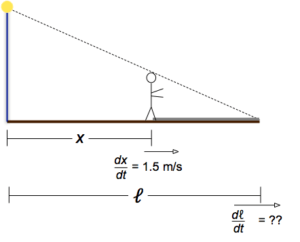
See the figure. We're calling the distance between the post and the "head" of the man's shadow โ, and the distance between the man and the post x.
2. Write an equation that relates the quantities of interest.
We are given that the man is walking away from the post at the rate ๐๐ฅ๐๐ก=1.5 m/s. We are looking for the rate at which the "head" of the man's shadow moves, which is ๐โ๐๐ก. We thus need to somehow relate โ to x, so we can then develop the relationship between their time-derivatives.
There's a subtlety to this problem that typically goes unaddressed: We're focusing on โ and ๐โ๐๐ก here because โ is the distance from the shadow's tip to the stationary post. We're not examining the shadow's length itself (labeled โโ๐ฅ in the left figure below) because that length is relative to the man's feet, which are also moving. So we'd find a different answer if we calculated the rate at which that gray shadow is changing. This problem asks us to find the rate the shadow's head as it moves along the (stationary) ground, so it's best to make our measurements from a point that isn't also movingโnamely, from the post. Hence we focus on โ and aim to compute ๐โ๐๐ก.
B. To develop your equation, you will probably use . . . similar triangles.
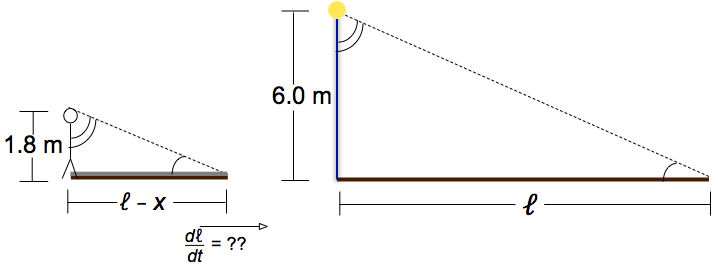
In the figure above we've separated out the two triangles. Notice that the angles are identical in the two triangles, and hence they are similar. The ratio of their respective components are thus equal as well. Hence the ratio of their bases (โโ๐ฅโ) is equal to the ratio of their heights (1.8m6.0m): โโ๐ฅโ=1.8m6.0m=0.30โโ๐ฅ=0.30โโโ0.30โ=๐ฅ(1โ0.30)โ=๐ฅ0.70โ=๐ฅ
3. Take the derivative with respect to time of both sides of your equation.
Regarding the preceding problem, students often ask what changes if the person walks toward instead of away from the light pole. The simple answer is that ๐๐ฅ๐๐ก gains a negative sign that you must insert by hand, which then propagates through the solution so that ๐โ๐๐ก emerges as a positive rather than negative value as it did in that problem. But it's probably worth tracing that through so you can see for yourself:
Man's shadow moves along the ground as he walks toward light pole
Practice Problem: Man walks toward light pole; shadow on ground moves
A 1.8-meter tall man walks toward a 6.0-meter light pole at the rate of 1.5 m/s. The light at the top of the pole casts a shadow behind the man. How fast is the "head" of his shadow moving along the ground?
Answer: โ2.1 m/s 1. Draw a picture of the physical situation.
See the figure. We're calling the distance between the pole and the "head" of the man's shadow โ, and the distance between the man and the pole x. 2. Write an equation that relates the quantities of interest.
We are given that the man is walking toward the pole at the rate ๐๐ฅ๐๐ก=โ1.5 m/s. (We've made the value negative because the distance x is decreasing as the man walks toward the pole.) We are looking for the rate at which the "head" of the man's shadow moves, which is ๐โ๐๐ก. We thus need to somehow relate โ to x, so we can then develop the relationship between their time-derivatives.
There's a subtlety to this problem that typically goes unaddressed: We're focusing on โ and ๐โ๐๐ก here because โ is the distance from the shadow's tip to the stationary pole. We're not examining the shadow's length itself (labeled โโ๐ฅ in the left figure below) because that length is relative to the man's feet, which are also moving. So we'd find a different answer if we calculated the rate at which that gray shadow is changing. This problem asks us to find the rate the shadow's head as it moves along the (stationary) ground, so it's best to make our measurements from a point that isn't also movingโnamely, from the pole. Hence we focus on โ and aim to compute ๐โ๐๐ก. B. To develop your equation, you will probably use . . . similar triangles.
In the figure above we've separated out the two triangles. Notice that the angles are identical in the two triangles, and hence they are similar. The ratio of their respective components are thus equal as well. Hence the ratio of their bases (โโ๐ฅโ) is equal to the ratio of their heights (1.8m6.0m):
โโ๐ฅโ=1.8m6.0m=0.30โโ๐ฅ=0.30โโโ0.30โ=๐ฅ0.70โ=๐ฅ3. Take the derivative with respect to time of both sides of your equation. ๐๐๐ก(0.70โ)=๐๐๐ก(๐ฅ)0.70๐โ๐๐ก=๐๐ฅ๐๐ก4. Solve for the quantity you're after.
We're looking for ๐โ๐๐ก: 0.70๐โ๐๐ก=๐๐ฅ๐๐ก๐โ๐๐ก=10.70๐๐ฅ๐๐ก=10.70(โ1.5ms)=โ2.1msโ
Man's shadow on the wall changes length as he walks
Practice Problem: Man walks, shadow on wall changes length
A 1.8-meter tall man walks toward a wall at 1.5 m/s. There is a spotlight on the
ground behind him, 20 meters away from the wall, that projects his shadow onto the wall.
At what rate is the length of his shadow changing when he is 5.0 meters from the wall?
1. Draw a picture of the physical situation.
See the figure. We've labeled the distance from the spotlight to the man x. The man is thus moving at the rate ๐๐ฅ๐๐ก=1.5ms. We're calling the height of his shadow on the wall y. The problem is asking us to find ๐๐ฆ๐๐ก at a particular moment, when the man is 5.0 meters from the wall. We'll use these values at the end of our solution.
2. Write an equation that relates the quantities of interest. A. Be sure to label as a variable any value that changes as the situation progresses; don't substitute a number for it yet.
The man's position changes as he walks, so we're calling his distance from the spotlight x. B. To develop your equation, you will probably use . . . similar triangles.
The problem gives us the rate ๐๐ฅ๐๐ก and asks us to find the rate ๐๐ฆ๐๐ก. We thus need to first relate y to x. The figure above suggests that we can use similar triangles to do so.
Here we've separated out the two triangles. Notice that their angles are identical, and hence the triangles are similar. The ratio of their respective components are thus equal: the ratio of their heights ๐ฆ1.8 is equal to the ratio of their bases 20๐ฅ. That is,
๐ฆ1.8=20๐ฅ๐ฆ=(1.8)(20)๐ฅ=36๐ฅ
That's it. That's the key relationship that will allow us to complete the solution. 3. Take the derivative with respect to time of both sides of your equation. Remember the chain rule. ๐๐๐ก๐ฆ=๐๐๐ก(36๐ฅ)๐๐ฆ๐๐ก=โ36๐ฅ2๐๐ฅ๐๐ก
Are you wondering why ๐๐ฅ๐๐ก appears? The answer is the Chain Rule.
While the derivative of 1๐ฅ with respect to x is
๐๐๐ฅ(1๐ฅ)=โ1๐ฅ2,
the derivative of 1๐ฅ with respect to time t is
๐๐๐ก(1๐ฅ)=โ1๐ฅ2๐๐ฅ๐๐ก.
(Recall that that rate is ๐๐ฅ๐๐ก=1.5ms in this problem.)
Remember that x is a function of time t: the man's position xchanges as time passes, which in turn causes the length of his shadow to change. We could have captured this time-dependence explicitly by writing our relation as
๐ฆ(๐ก)=36๐ฅ(๐ก)
to remind ourselves that both y and x are functions of time t. Then when we take the derivative,
๐๐๐ก๐ฆ(๐ก)=๐๐๐ก36๐ฅ(๐ก)๐๐ฆ๐๐ก=โ36[๐ฅ(๐ก)]2๐๐ฅ๐๐ก
[Recall ๐๐ฅ(๐ก)๐๐ก=1.5ms, and we're looking for ๐๐ฆ(๐ก)๐๐ก at the moment when ๐ฅ(๐ก)=5.0 m.]
Most people find that writing the explicit time-dependence ๐ฆ(๐ก) and x(t) annoying, and so just write y and x instead. Regardless, you must remember that both y and x depend on t, and so when you take the derivative with respect to time the Chain Rule applies and you have the ๐๐ฅ๐๐ก term.
4. Solve for the quantity you're after.
We're given that ๐๐ฅ๐๐ก=1.5ms. The problem asks us to find ๐๐ฆ๐๐ก at the moment the man is 5.0 meters from the wall. Hence at the moment of interest the value of x is:
๐ฅ=20mโ5.0m=15.0m
Finally, then:
๐๐ฆ๐๐ก=โ36๐ฅ2๐๐ฅ๐๐ก=โ36(15.0)2(1.5ms)=โ0.24msโ
That is, the man's shadow is changing at the rate ๐๐ฆ๐๐ก=โ0.24ms. The negative value indicates that the shadow's height y is decreasing, as we expect.
Caution: IF you are using a web-based homework system and the question asks,
At what rate does the shadow's height decrease?
then the system has already accounted for the negative sign and so to be correct you must enter a POSITIVE VALUE: 0.24msโ
Water drains from a cone at constant rate; water's level falls at what rate?
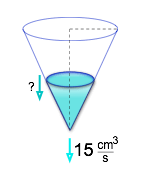
How fast is the water level falling as water drains from the cone?
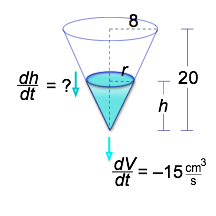
An inverted cone is 20 cm tall, has an opening radius of 8 cm, and was initially full of water. The water drains from the cone at the constant rate of 15 cm3 each second. The water's surface level falls as a result. At what rate is the water level falling when the water is halfway down the cone? (Note: The volume of a cone is 13๐๐2โ. You may leave ๐ in your answer; do not use a calculator to find a decimal answer.)
View/Hide Solution
Let's unpack the question statement:
We're told that volume of water in the cone V is changing at the rate of ๐๐๐๐ก=โ15 cm3/s. (We must insert the negative sign "by hand" since we are told that the water is draining out, and so its volume is decreasing.)
As a result, the water's height in the cone h is changing at the rate ๐โ๐๐ก, which is the quantity we're after.
The inverted cone has a radius of 8 cm at its top, and a full height of 20 cm.
The problem is asking us about ๐โ๐๐ก at a particular instant, when the water is halfway down the cone, and so when โ=10 cm. We'll use this value toward the end of our solution.
1. Draw a picture of the physical situation.
See the figure.
2. Write an equation that relates the quantities of interest.
A. Be sure to label as a variable any value that changes as the situation progresses; don't substitute a number for it yet.
The height of the water changes as time passes, so we're going to keep that height as a variable, h.
B. To develop your equation, you will probably use . . . similar triangles.
This is the hardest part of Related Rates problem for most students initially: you have to know how to develop the equation you need, how to pull that "out of thin air." By working through these problems you'll develop this skill. The key is to recognize which of the few sub-types of problem it is, as listed in our Problem Solving Strategy box at the top of the page.
Here we need to develop a relationship between the rate we're given, ๐๐๐๐ก=โ15 cm3/s, and the rate we're after, ๐โ๐๐ก. We thus first need to write down a relationship between the water's volume V and its height-in-the-cone h. But we know that relationship since it was given in the problem statement: ๐=13๐๐2โ Notice that this relation expresses the water's volume as the function of two variables, r and h. We can only take the derivative with respect to one variable, so we need to eliminate one of those two. Since the question asks us to find the rate at which the water is falling when its at a particular height, let's keep h and eliminate r as a variable using similar triangles.
Begin subproblem to eliminate r as a variable.
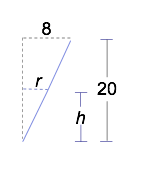
The figure is the same as in Step 1, but with the rest of the cone removed for clarity. Note that there are two triangles, a small one inside a larger one. Because these are similar triangles, the ratio of the base of the small triangle to that of the big triangle (๐8) must equal the ratio of the height of the small triangle to that of the big triangle (โ20):
๐8=โ20 Hence ๐=820โ=25โ
End subproblem.
Now let's substitute the expression we just found for r into our relation for V:
Are you wondering why that ๐โ๐๐ก appears? The answer is the Chain Rule.
While the derivative of โ3 with respect to h is ๐๐โโ3=3โ2, the derivative of โ3 with respect to time t is ๐๐๐กโ3=3โ2๐โ๐๐ก.
Remember that h is a function of time t: the water's height decreases as time passes. We could have captured this time-dependence explicitly by always writing the water's height as h(t), and then explicitly showing the water's volume in the cone as a function of time as
[Recall that we're looking for ๐โ(๐ก)๐๐ก in this problem.]
Most people find that writing the explicit time-dependence V(t) and h(t) annoying, and so just write V and h instead. Regardless, you must remember that h depends on t, and so when you take the derivative with respect to time the Chain Rule applies and you have the ๐โ๐๐ก term.
4. Solve for the quantity you're after.
We have ๐๐๐๐ก=โ15cm3s, and want to find ๐โ๐๐ก at the instant when h = 10 cm. Starting from our preceding expression, let's first solve for ๐โ๐๐ก and then substitute the values we're given:
๐๐๐๐ก=425๐โ2๐โ๐๐ก๐โ๐๐ก=254๐โ2๐๐๐๐ก=254๐(10)2(โ15)=254๐(100)(โ15)=โ1516๐cm/sโ That's the answer. The negative value indicates that the water's height h is decreasing, as we expect.
Caution: IF you are using a web-based homework system and the question asks,
At what rate does the water's height decrease?
then the system has possibly already accounted for the negative sign and so to be correct you must enter a POSITIVE VALUE: 1516๐cmsโ
This has everything to do with how the coder entered this problem into your homework system and nothing to do with the math or your understanding!
The following problem is essentially the same as the preceding one, except that water flows into instead of out of the cone. We include it here so you can see how the sign of ๐๐๐๐ก propogates through to change the sign of ๐โ๐๐ก, something students often ask about.
Water fills a cone at constant rate; water's level rises at what rate?
Practice Problem: Water fills a cone
Water is poured at a uniform rate of 15cm3s into a cup whose inside is shaped like a cone. The radius of the opening is 6 cm, and the height of the cup is 16 cm. How fast is the water level rising when the water is halfway up? (Note: The volume of a cone is 13๐๐2โ. You may leave ๐ in your answer; do not use a calculator to find a decimal answer.)
Answer:53๐ cm/s 1. Draw a picture of the physical situation.
See the top figure. 2. Write an equation that relates the quantities of interest.
We are given that the volume of water in the cup is increasing at the rate ๐๐๐๐ก=15cm3s.
We want to find the rate at which the water is rising, ๐โ๐๐ก, at the instant when the water is halfway up the cup, so when โ=8 cm.
A. Be sure to label as a variable any value that changes as the situation progresses; don't substitute a number for it yet.
The height of the water changes as time passes, as does the water's surface area, so we're going to keep both of those as a variables, h and r.
We have a relation between the volume of water in the cup at any moment and those variables: ๐=13๐๐2โB. To develop your equation, you will probably use . . . similar triangles.
We don't want the radius ๐ to appear as a separate variable, so we need to eliminate it. We can do so by using the similar triangles shown in the lower figure. Because the small triangle is similar to the larger triangle it's embedded in, the ratio of their bases (๐6) must be equal to the ratio of their heights (โ16) ๐6=โ16๐=616โ=38โ
Then substituting this expression into our relation for ๐: ๐=13๐(38โ)2โ=364๐โ33. Take the derivative with respect to time of both sides of your equation. Remember the chain rule. ๐๐๐๐ก=๐๐๐ก(364๐โ3)=364๐(3โ2๐โ๐๐ก)=964๐โ2๐โ๐๐ก4. Solve for the quantity you're after.
We have ๐๐๐๐ก=15cm3s, and want to find ๐โ๐๐ก, at the instant when โ=8 cm. ๐โ๐๐ก=649๐โ2๐๐๐๐ก=649๐(8)2(15)=643๐(64)(5)=53๐cm/sโ
Related Rates: Using the Pythagorean Theorem
And probably more than any other approach, you will find yourself invoking the Pythagorean theorem often. The typical clue to use this approach will be that you've drawn a right triangle, and are asked something about a distance that happens to equal the hypotenuse.
Note again the importance of starting with a clear figure, so that you can see the right triangle!
The following problems illustrate.
Ladder slides down a wall; how fast does the top move down (video solution)
How fast is the ladder's top sliding down?
A 10-ft ladder is leaning against a house on flat ground. The house is to the left of the ladder. The base of the ladder starts to slide away from the house. When the base has slid to 8 ft from the house, it is moving horizontally at the rate of 2 ft/sec. How fast is the ladder's top sliding down the wall when the base is 8 ft from the house?
View/Hide Solution
We have a video for this solution; a full written-out solution is below.
1. Draw a picture of the physical situation.
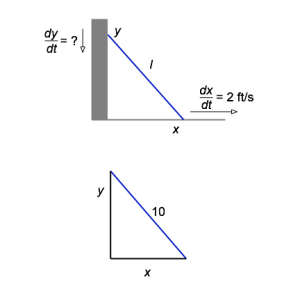
Let x be the horizontal distance, in feet, from the wall to the bottom of the ladder.
Let y be the distance, in feet, from the ground to the top of the ladder.
The problem tells us that at the moment of interest, when x = 8 ft, ๐๐ฅ๐๐ก=2 ft/sec. We'll use these values only at the end of our solution.
2. Write an equation that relates the quantities of interest.
A. Be sure to label as a variable any value that changes as the situation progresses; don't substitute a number for it yet. In this situation, both x and y change as the ladder slides, so we will leave both quantities as variables.
B. To develop your equation, you will probably use . . . the Pythagorean theorem. This is the hardest part of Related Rates problem for most students initially: you have to know how to develop the equation you need, how to pull that "out of thin air." By working through these problems you'll develop this skill. The key is to recognize which of the few sub-types of problem it isas described in the Problem Solving Strategy box at the top of this page. In this problem, the diagram above immediately suggests that we're dealing with a right triangle. Furthermore, we need to related the rate at which y is changing, ๐๐ฆ๐๐ก, to the rate at which x is changing, ๐๐ฅ๐๐ก, and so we first need to write down an equation that somehow relates x and y.
While x and y change as the ladder slides, the hypotenuse of the right triangle shown is always equal to the ladder's length, 10 ft. Hence the Pythagorean theorem applies: ๐ฅ2+๐ฆ2=(10)2=100 That's it. That's the key relation we need to be able to proceed with the rest of the solution.
3. Take the derivative with respect to time of both sides of your equation. Remember the chain rule.
For the relevant discussion in the video, this player jumps ahead to 5:40:
While the derivative of ๐ฅ2 with respect to x is ๐๐๐ฅ๐ฅ2=2๐ฅ, the derivative of ๐ฅ2 with respect to time t is ๐๐๐ก๐ฅ2=2๐ฅ๐๐ฅ๐๐ก. Similarly, the derivative with respect to time t of ๐ฆ2 is ๐๐๐ก๐ฆ2=2๐ฆ๐๐ฆ๐๐ก.
Remember that x and y are both functions of time t: both positions change as time passes and the ladder slides down the wall. We could have captured this time-dependence explicitly by writing our relation as [๐ฅ(๐ก)]2+[๐ฆ(๐ก)]2=100 to remind ourselves that both x and y are functions of time t. Then when we take the derivative, ๐๐๐ก([๐ฅ(๐ก)]2+[๐ฆ(๐ก)]2)=๐๐๐ก(100)2๐ฅ(๐ก)๐๐ฅ๐๐ก+2๐ฆ(๐ก)๐๐ฆ๐๐ก=0
[Recall ๐๐ฅ๐๐ก=2 ft/s at the moment of interest, and we're looking for ๐๐ฆ๐๐ก.]
Most people find that writing the explicit time-dependence x(t) and y(t) annoying, and so just write x and y instead. Regardless, you must remember that both x and y depend on t, and so when you take the derivative with respect to time the Chain Rule applies and you have the ๐๐ฅ๐๐ก and ๐๐ฆ๐๐ก terms.
4. Solve for the quantity you're after.
The question is asking us to find ๐๐ฆ๐๐ก at the instant when x = 8 ft and ๐๐ฅ๐๐ก=2 ft/sec. So let's solve the preceding equation for ๐๐ฆ๐๐ก: 2๐ฅ๐๐ฅ๐๐ก+2๐ฆ๐๐ฆ๐๐ก=02๐ฆ๐๐ฆ๐๐ก=โ2๐ฅ๐๐ฅ๐๐ก๐๐ฆ๐๐ก=โ๐ฅ๐ฆ๐๐ฅ๐๐ก[โ] To complete the calculation, we need to know the value of y at the instant when x = 8.
Begin subproblem to find the value of y at the instant when x = 8 ft.
We can find this value by using the Pythagorean theorem: (8)2+๐ฆ2=100๐ฆ2=100โ64=36๐ฆ=6 End subproblem.
Substituting all of the known values into the equation marked [*] above, we have: ๐๐ฆ๐๐ก=โ๐ฅ๐ฆ๐๐ฅ๐๐ก=โ86(2)=โ83ft/sโ That's the answer. The negative value indicates that the top of the ladder is sliding down the wall, in the negative-y direction.
Caution: IF you are using a web-based homework system and the question asks,
At what rate does the ladder slide down the wall?
then the system may have already accounted for the negative sign and so to be correct you may need to enter a POSITIVE VALUE: 83ftsโ
This is annoying we agree, and has everything to do with whoever entered the problem into the system. Making matters worse, since different problems were probably entered by different people, within a given problem set you may find inconsistencies here; the best we can do is help you be aware.
Rectange maintains constant area as its sides change; find the rate its diagonal changes
Practice Problem: Morphing rectangle
A rectangle has constant area 500 square centimeters. Its length is increasing at
the rate of 8 centimeters per second.
At what rate is the diagonal of the rectangle changing at the instant when its width is
10 centimeters? (Do not use a calculator. You may leave a square root in your answer.)
1. Draw a picture of the physical situation.
See the figure. 2. Write an equation that relates the quantities of interest. A. Be sure to label as a variable any value that changes as the situation progresses; don't substitute a number for it yet.
Both the width and the length of the rectangle are changing, so let's leave them both as variables. B. To develop your equation, you will probably use . . .the Pythagorean theorem.
We need to relate the rectangle's diagonal to its width and length: ๐2=๐ค2+๐23. Take the derivative with respect to time of both sides of your equation. Remember the chain rule.
Both ๐ค and ๐ are changing with time, and so when we take the derivative we must include ๐๐ค๐๐ก and ๐๐๐๐ก terms: ๐๐๐ก๐2=๐๐๐ก(๐ค2+๐2)2๐๐๐๐๐ก=2๐ค๐๐ค๐๐ก+2๐๐๐๐๐ก๐๐๐๐๐ก=๐ค๐๐ค๐๐ก+๐๐๐๐๐ก[*]4. Solve for the quantity you're after.
We want to find ๐๐๐๐ก at the instant when ๐ค=10 cm. The problem statement tells us that ๐๐๐๐ก=8 cm/s. In order to use the preceding equation (marked [*]), we need to determine ๐ and ๐ at this instant, and also ๐๐ค๐๐ก at this instant.
First, we can find ๐ by noting that the rectangle has constant area, ๐ด=500=๐๐ค. Hence when ๐ค=10 cm: ๐=๐ด๐ค=50010=50cm
Second, we can find ๐ at this instant using the Pythagorean theorem: ๐2=๐ค2+๐2=(10)2+(50)2=100+2500=2600๐=โ2600=10โ26
Next, we can find ๐๐ค๐๐ก at this instant by taking the derivative of ๐ด=500=๐๐ค : ๐๐๐ก(500)=๐๐๐ก(๐๐ค)0=๐๐๐ค๐๐ก+๐ค๐๐๐๐ก๐๐๐ค๐๐ก=โ๐ค๐๐๐๐ก
Hence
๐๐ค๐๐ก=โ(๐ค๐)(๐๐๐๐ก)=โ(1050)(8)=โ85cm/s
Then substituting values into the equation marked [*] above: ๐๐๐๐๐ก=๐ค๐๐ค๐๐ก+๐๐๐๐๐ก(10โ26)๐๐๐๐ก=(10)(โ85)+(50)(8)=โ16+400=384๐๐๐๐ก=38410โ26=38.4โ26cm/sโ
Kite flies horizontally; find the rate at which the length of the string is changing
Practice Problem: Kite, length changes
A kite flies 30 meters above ground. It travels horizontally at 2 meters per
second. How fast is the string unspooling at the moment the distance to the kite is 50
meters?
1. Draw a picture of the physical situation.
See the figure. We've called the length of string to the kite โ. The problem is asking for the rate at which that length changes (= the rate at which the string is unspooling), ๐โ๐๐ก, at a particular moment โ when โ=50 meters. Recall also that the kite is moving horizontally, in the x-direction, at the rate ๐๐ฅ๐๐ก=2ms. We'll use these values at the end of our solution.
2. Write an equation that relates the quantities of interest. A. Be sure to label as a variable any value that changes as the situation progresses; don't substitute a number for it yet.
The string's length changes as the situation progresses, so we're calling that the variable โ. B. To develop your equation, you will probably use . . . the Pythagorean theorem.
In this problem, the diagram above immediately suggests that we're dealing with a right triangle. Furthermore, we need to related the rate at which the string's length โ is changing, ๐โ๐๐ก, to the rate at which x is changing, ๐๐ฅ๐๐ก. Hence we must first write down an equation that somehow relates โ and x. The Pythagorean theorem gives us that relation:
โ2=๐ฅ2+(30)2
That's it. That's the key relationship that will allow us to complete the solution.
3. Take the derivative with respect to time of both sides of your equation. Remember the chain rule. ๐๐๐กโ2=๐๐๐ก๐ฅ2+๐๐๐ก30202โ๐โ๐๐ก=2๐ฅ๐๐ฅ๐๐กโ๐โ๐๐ก=๐ฅ๐๐ฅ๐๐ก4. Solve for the quantity you're after.
Let's solve the preceding equation for ๐โ๐๐ก:
๐โ๐๐ก=๐ฅโ๐๐ฅ๐๐ก
To complete the solution, we need to know the value of x at the instant when โ=50 m.
Begin subproblem to find x at the moment of interest.
Recall from the Pythagorean theorem that at every moment
โ2=๐ฅ2+(30)2
Hence when โ=50 m,
๐ฅ2=โ2โ302=(50)2โ302=1600๐ฅ=40
As a faster approach, you might have noticed that this is a 30-___-50 right triangle, and so as a "3-4-5 right triangle" the missing length has to be 40. End subproblem.
We can now substitute values into our preceding equation:
๐โ๐๐ก=๐ฅโ๐๐ฅ๐๐ก
We have ๐ฅ=40 m, โ=50 m, and ๐๐ฅ๐๐ก=2ms:
๐โ๐๐ก=๐ฅโ๐๐ฅ๐๐ก=40m50m(2ms)=1.6msโ
Two joggers run toward an intersection; find the rate at which the distance between them changes
Practice Problem: Jogging toward an intersection
Two students, Ann and Frederick, are jogging along straight roads that intersect at
right angles. Ann is heading West and approaching the intersection at a speed of 5 mph.
Frederick is heading North and is approaching the intersection at a speed of 6 mph. At
noon, as both Ann and Frederick are approaching the intersection, Ann is 3 miles from
the intersection and Frederick is 4 miles from the intersection.
At what rate is the distance between Ann and Frederick decreasing at noon?
Answer:โ395 mph
1. Draw a picture of the physical situation.
See the figure. We'll call Ann's distance from the intersection ๐ฅ, and Frederick's distance from the intersection ๐ฆ.
Let's call the distance between them at any instant ๐, as indicated in the lower figure. The question is asking us to find ๐๐๐๐ก at noon.
2. Write an equation that relates the quantities of interest. A. Be sure to label as a variable any value that changes as the situation progresses; don't substitute a number for it yet.
In this scenario, both of the jogger's positions change over time, so we're leaving each of their positions as a variable. B. To develop your equation, you will probably use . . . the Pythagorean theorem.
We can relate ๐ to ๐ฅ and ๐ฆ using the Pythagorean theorem: ๐2=๐ฅ2+๐ฆ23. Take the derivative with respect to time of both sides of your equation. Remember the chain rule. ๐๐๐ก(๐2)=๐๐๐ก(๐ฅ2+๐ฆ2)2๐๐๐๐๐ก=2๐ฅ๐๐ฅ๐๐ก+2๐ฆ๐๐ฆ๐๐ก๐๐๐๐๐ก=๐ฅ๐๐ฅ๐๐ก+๐ฆ๐๐ฆ๐๐ก[*]4. Solve for the quantity you're after.
We want to find ๐๐๐๐ก at noon, when ๐ฅ=3 miles and ๐ฆ=4 miles. We also know that ๐๐ฅ๐๐ก=โ5 mph, and ๐๐ฆ๐๐ก=โ6 mph.
(Note that we must insert both negative signs "by hand" since both ๐ฅ and ๐ฆ are decreasing as the joggers head toward the intersection.)
To solve the preceding equation for ๐๐๐๐ก, we also need to know ๐; this we can find by using the Pythagorean theorem at this instant: ๐2=๐ฅ2+๐ฆ2=32+42=25๐=5
Then substituting values into the equation marked [*] above: ๐๐๐๐๐ก=๐ฅ๐๐ฅ๐๐ก+๐ฆ๐๐ฆ๐๐ก(5)๐๐๐๐ก=(3)(โ5)+(4)(โ6)=โ15โ24=โ39๐๐๐๐ก=โ395mphโ
The negative value indicates that the distance between the joggers is decreasing as they jog toward each other.
Two ships travel at right angles; find the rate at which the distance between them changes
Practice Problem: Ships travel
Ship Blue travels north, in the y-direction, at 20 kilometers per hour. Ship Red travels east, in the x-direction, at 30 kilometers per hour. At 9:00 AM, ship Blue is 100 kilometers east of Ship Red. At what rate is the distance between the ships increasing at noon?
1. Draw a picture of the physical situation.
See the figures. On the left, we've shown the situation at 9:00 AM, with ship Blue 100 km east of ship Red. On the right, we've shown the ships at some arbitrary time t later: ship Red has moved to the east a distance x, and ship Blue has moved to the north a distance y. We've labeled the distance between the ships โ. We're looking for ๐โ๐๐ก at particular moment, 12:00-noon, a fact we'll use at the end of the solution.
2. Write an equation that relates the quantities of interest. A. Be sure to label as a variable any value that changes as the situation progresses; don't substitute a number for it yet.
Both ship Red and ship Blue's positions change, so we've called the distances they travel x and y respectively.
B. To develop your equation, you will probably use . . . the Pythagorean theorem.
In this problem, we're given values for ๐๐ฅ๐๐ก and ๐๐ฆ๐๐ก, and asked to find the value for ๐โ๐๐ก at a particular moment. We thus first need to relate โ to x and y.
The figure above suggests how to do so: the Pythagorean theorem. Specifically, at every moment we have
โ2=(100โ๐ฅ)2+๐ฆ2
That's it. That's the key relationship that will allow us to complete the solution. (Note, by the way, how critical drawing the figure correctly is to being able to solve this problem.) 3. Take the derivative with respect to time of both sides of your equation. Remember the chain rule. ๐๐๐ก[โ2]=๐๐๐ก[(100โ๐ฅ)2]+๐๐๐ก[๐ฆ2]2โ๐โ๐๐ก=2(100โ๐ฅ)(โ1)๐๐ฅ๐๐ก+2๐ฆ๐๐ฆ๐๐กโ๐โ๐๐ก=โ(100โ๐ฅ)๐๐ฅ๐๐ก+๐ฆ๐๐ฆ๐๐ก 4. Solve for the quantity you're after.
Let's solve the preceding equation for ๐โ๐๐ก:โ๐โ๐๐ก=โ(100โ๐ฅ)๐๐ฅ๐๐ก+๐ฆ๐๐ฆ๐๐ก๐โ๐๐ก=โ(100โ๐ฅ)๐๐ฅ๐๐ก+๐ฆ๐๐ฆ๐๐กโ(โ)
We know ๐๐ฅ๐๐ก=30kmhr and ๐๐ฆ๐๐ก=20kmhr. To complete the problem, we need to know the values of x,y, and โ at the moment of interest.
Begin subproblem to find x, y, and โ.
We're interested in the particular moment 12:00-noon, which is t = 3 hours after our initial picture at 9:00 AM. Hence
๐ฅ=(30kmhr)(3hr)=90km๐ฆ=(20kmhr)(3hr)=60km
And using the Pythagorean theorem we can find โ at this moment:
โ2=(100โ๐ฅ)2+๐ฆ2=(100โ90)2+(60)2=3700โ=โ3700=60.83kmEnd subproblem.
We finally substitute all of these values into our equation marked (*):
๐โ๐๐ก=โ(100โ๐ฅ)๐๐ฅ๐๐ก+๐ฆ๐๐ฆ๐๐กโ=โ(100โ90)(30)+(60)(20)60.83=โ300+120060.83=14.8kmhrโ
Rocket flies straight up; find the rate at which the distance between the rocket and an observer changes
Practice Problem: Rocket, distance changes
A rocket is launched straight up, and its altitude is ๐ฆ=5๐ก2 meters after t seconds. You are on the ground 500 meters from the launch site. At what rate is the distance from you to the rocket changing 6 seconds after the launch?
1. Draw a picture of the physical situation.
See the figure. We've labeled the rocket's vertical position at any moment after launch y, and the distance from you to the rocket โ. The question is asking us to find ๐โ๐๐ก at a particular moment, 6 seconds after launchโa fact we'll use at the end of our solution.
2. Write an equation that relates the quantities of interest. A. Be sure to label as a variable any value that changes as the situation progresses; don't substitute a number for it yet.
The rocket's vertical position changes as the time passes, so we're calling that the variable y. B. To develop your equation, you will probably use . . . the Pythagorean theorem.
We're looking for ๐โ๐๐ก, and we know (actually: we can easily determine) the rate at which the rocket's y- position is changing, ๐๐ฆ๐๐ก. We thus first need to related โ to y.
The figure above suggests how to do so: the Pythagorean theorem. Specifically, at every moment we have
โ2=(500)2+๐ฆ2
That's it. That's the key relationship that will allow us to complete the solution. (Note, by the way, how critical drawing the figure correctly is to being able to solve this problem.)
3. Take the derivative with respect to time of both sides of your equation. Remember the chain rule. ๐๐๐ก(โ2)=๐๐๐ก(500)20+๐๐๐ก(๐ฆ2)2โ๐โ๐๐ก=2๐ฆ๐๐ฆ๐๐กโ๐โ๐๐ก=๐ฆ๐๐ฆ๐๐ก 4. Solve for the quantity you're after.
Let's solve the preceding equation for ๐โ๐๐ก:โ๐โ๐๐ก=๐ฆ๐๐ฆ๐๐ก๐โ๐๐ก=๐ฆโ๐๐ฆ๐๐ก(โ)
To complete our solution, we need to know the values of y,โ, and ๐โ๐๐ก 6 seconds after launch.
Begin subproblems to find y, โ, and ๐โ๐๐ก. A. Find y.
The problem states that ๐ฆ=5๐ก2 meters after t seconds. Hence 6 seconds after launch
๐ฆ=5(6)2=180mB. Find โ.
By the Pythagorean theorem, at this instant
โ2=(500)2+(180)2=282400โ=โ282400=531mC. Find ๐๐ฆ๐๐ก.
Since ๐ฆ=5๐ก2,๐๐ฆ๐๐ก=10๐ก
Hence at ๐ก=6 seconds,
๐๐ฆ๐๐กโฃ6s=10(6)=60msEnd subproblems.
We can now substitute these values into our equation marked (*) above:
๐โ๐๐ก=๐ฆโ๐๐ฆ๐๐ก=180531(60)=20.3msโ