A.2 Sigma Notation; Increasing the Number of Subintervals
On this screen we review sigma notation. We will be using a lot of it on the upcoming screens — because the integral is defined using this notation — so we need to be sure you are completely comfortable with it. Once we've done some review, we'll revisit Scenario 1 from the preceding screen and continue our development now using sigma notation.
Sigma Notation and Sums
You've probably seen sigma sum notation before, something likeThe key points:
- The left side of the equation is "sigma notation" because it uses the Greek upper-case capital letter
Σ , - The formula we're using for each term in the sum,
( 2 𝑖 + 1 ) , - The letter
𝑖 - The sum's lower limit
𝑖 = 0 Σ , ( 2 ⋅ 0 + 1 ) - We then increment
𝑖 𝑖 = 1 ( 2 ⋅ 1 + 1 ) - we reach the sum's upper limit, 3, shown at the top of the
Σ . ( 2 ⋅ 3 + 1 ) .
 Traditionally we use the letter n to represent that upper-limit value, whatever it is:
We could of course have a larger upper limit than 3: the slider below lets you choose whatever value you'd like, up to n = 25. (We could go larger still, but you get the idea.)
Currently the summation's upper limit n = 3.
The key point is that as you increase the upper limit, the number of terms on the right-hand side of the equation becomes quite unwieldy. No one wants to write all of those out! The utility of the sigma notation is that we don't have to spend time with all that writing; instead we have this very compact way to represent them all.
But let's be clear: the sigma notation on the left-hand side and all of the terms on the right-hand side of the equation are simply two ways of representing the same thing. When you see such sigma notation, you must broadly envision the many terms on the right as if they were all written out. There's nothing magical happening with any of this; the
Summation Index and Dummy Variables
Traditionally letters from the middle of the alphabet — specifically, i, j and k — are used as summation indicies. (By the way, in mathematics the plural of "index" is usually "indicies." "Indexes" is not wrong, just not typically used in this context.)
Notice that we can choose whatever letter we'd like for the index without affecting the actual sum:
The index is a dummy variable
The index is merely a placeholder that lets us track where we are between the lower and upper limits, and as such we can call it whatever we want. For this reason the index is known as a dummy variable: you can change it within the sigma notation without consequence. You do have to be consistent and use the same name in the lower limit and in the summand itself. For example, mixing the variables i and k in
Quick note for those familiar with computer programming: The index is a variable local to the sigma summation, the same as it is within a for-loop: it doesn't exist outside of the loop. The usage is exactly the same here.
Shifting the Index
Let's introduce how to "shift the index." We'll do some index shifting on upcoming screens, and it'll be easier to handle then if you already understand the approach.
Sticking with our original 4-term example from above,
Let's say that, for some reason, you don't want your sigma-summation
- The lower limit was
𝑖 = 0 𝑗 = 0 + 1 = 1 . - The upper limit was
𝑖 = 3 , 𝑗 = 3 + 1 = 4 . - For the summand, we can rewrite
𝑗 = 𝑖 + 1 𝑖 = 𝑗 − 1 .
Then our original summand( 2 𝑖 + 1 ) [ 2 ( 𝑗 − 1 ) + 1 ] = ( 2 𝑗 − 1 ) .
The original sum
Notice that our new sigma notation using j produces exactly the same sum as we had above. (Of course: math works!) Remember, the sigma-notation is merely a compact way of writing the sum that appears on the right-hand side, and how exactly you write it — using i, j or k as the index, or shifting the index up or down — doesn't matter, as long as the compact representation correctly represents the (expanded) sum. If you'd like, try shifting the index by 99, or -63, or whatever number you'd like to verify this for yourself.
And notice that since j is a dummy variable, we're free to switch the name from j back to i if we'd like:
The following problem lets you practice shifting an index for yourself. This question illustrates an occasional occurance: you end up with a summand that just doesn't "look right" given the context, and so you want to alter it by shifting.
Note: We'll be honest: since this is a multiple choice question, a fine way to determine the answer is to imagine writing out the sum, with a focus on the first and last terms, to see which answer choice gives you the same terms as the original form. That said, you might also take the opportunity to try making the subsitution j = ... as we did above to practice for yourself.
The longer approach is to keep the goal in mind that we want the summand to be simply i, which is the same thing as making it simply j (because these are dummy variables). Hence we're making the substitution
We typically start our indexing
with i = 1.
Our standard practice will be use
Revisiting Draining Container
Let's use sigma notation to revisit, and extend, our examination of how much liquid drains from the container on the previous screen. As a reminder, in this scenario we're pretending that the liquid flows out at the rate
Overestimate
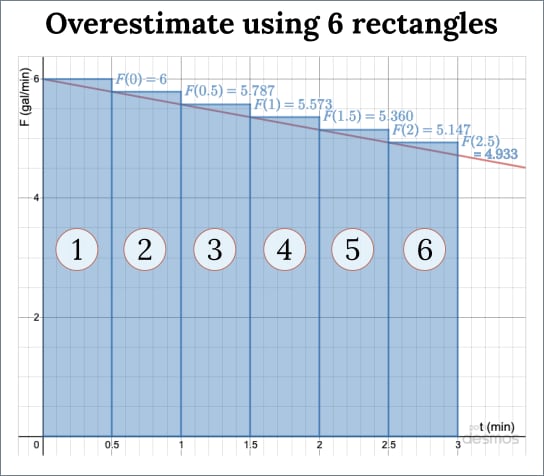
To begin, we'll again consider an overestimate for the actual amount of water that flows out over the first three minutes after we open the drain. Recall that for this overestimate, we use the flowrate value at the start of each subinterval, at its leftmost point, and thereby compute the left sum,
We're going to extend a bit and use twice as many rectangles as we did before, so 6 total, as shown in the figure below. As you see, we've also assigned an index to each subinterval: i = 1, 2, 3, 4, 5, and 6. While we happen to be using 6 subintervals to build up our sum, we'll need to generalize to any integer number n of them; you'll see below how this number n of subintervals is the same as the n we'll use as the upper-limit in our sigma notation.
Also recall the two Big Steps to our approximation approach for the overestimate:
1. Determine the overestimate for the amount accumulated in each subinterval:
2. Sum the overestimated amounts accumluated for all of the subintervals.
We know for the 6 subintervals the overestimate of the total accumulated amount is
Now we want to generalize that sum, using sigma notation, for any number intervals n. What we're aiming for is this:
So we need to focus on the summand, which is to say Step 1 above. Since this is our first time determining how to form the summand in terms of i, we're going to proceed rather slowly through this part. We'll be developing a lot of intergrals this way going forward, and want to be sure you're with us line-by-line so you can do this on your own.
Let's consider first the duration of the subintervals, which we see from the figure are
Next, remember that our flowrate is a function of time t:
The result of this step will always look something like that; the only trick is deciding whether the i-term is
Generalizing that equation for
We can now complete Step 1 for the overestimate (whew!), which recall is (1) Determine the overestimate for the amount accumulated in each subinterval:
Step 2 is then straightforward: we sum the amount accumulated for subintervals 1 through n, for however-many subintervals n we happen to be using:
Now, ready? Let's put all of the pieces together and tie the sum to the graph for any number n of subintervals that you can set:
Underestimate
Let's consider now the underestimate for the amount of water that flows out during the first three minutes, again using six subintervals. Having laid so much groundwork above, we'll go a bit faster here.
To determine the underestimate for the total amount we:
1. Determine the underestimate for the amount accumulated in each subinterval:
2. Sum the underestimated amounts accumluated for all of the subintervals.
As above, the duration of each of the 6 subintervals is
Indeed, the only difference from the overestimate above is that in Step 1 we now want the minimum flowrate instead of the maximum flowrate. As you recall from the previous screen, that minimum flowrate occurs at the end of each subinterval as shown in the figure. We thus use the rightmost point, and are computing the right sum,  For Step 1, let's focus on one subinterval to get the details right; we'll arbitrarily choose
because the minimum flowrate for subinterval #2 is
Hence completing Step 1, we have
Then immediately moving on to Step 2, the sum of the accumulated amount for n subintervals is
Let's check by writing out the terms of that sum for n = 6:
If you compare those terms to the figure above, you'll see that our sigma notation does indeed correctly match the sum that we're after.
And with that, we'll let you again vary the value of n for yourself:
We've illustrated the key points we needed to for now, so we're actually to leave Context 1 here for the time being. On the next screen we'll introduce a new scenario, one that requires a bit more thought to develop the accumulation that we're after.
The Upshot
- Sigma notation lets us compactly write many terms in a sum no matter how many terms there are.
- We can write our over- and under-approximations for the amount of liquid that flows out of the container in Context 1 as
𝑛 ∑ 𝑖 = 1 𝐹 ( 𝑡 𝑖 ) Δ 𝑡 Δ 𝑡 = 3 m i n 𝑛 , 𝑡 𝑖
We know the part above about determining what
How helpful was this page?
Our goal is to provide the best content we can, for free to any student looking to learn well, and your feedback helps us improve.