A.3 Introducing Linear Approximations
On this screen we'll introduce one of the most important uses of Calculus: how to do a linear approximation. We'll learn how to quickly estimate something like
Deep Dive: Linear Approximation of ( 3 . 0 1 ) 2
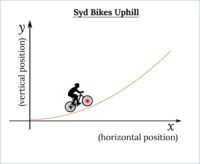
To start, recall that in the preceding Topic we considered the scenario of Syd biking up a curved path. As he passed the horizontal position
And we calculated his vertical position after he had moved forward the small horizontal distance dx as
Let's now consider a more mathematical example. Note that while the words may be different, the ideas and calculations are exactly the same as in that scenario. Keep the picture of Syd biking uphill in your mind as you consider the requested calculation.
Example 1:
 Consider the function
You know that at
For now, we'll simply tell you that the rate the function "climbs" at
- Use the information provided to find the (approximate) value of
𝑓 ( 3 . 0 1 ) .
Hint: The calculation is exactly the same as finding Syd's vertical position𝑦 ( 3 . 0 1 ) . - Although the approximation will be less good for reasons we'll see, use the same approach to find the approximate value of
𝑓 ( 3 . 5 ) .
Solution.
(b) The formulation for this calculation is the same, but now we have
Let's now use the following Activities to dig in and see why in Example 1 the approximation for
ACTIVITY 1.1: Zooming in on the curve
LINEAR APPROXIMATION: Replace a bit of the curve with an appropriate line
As the preceding Activity illustrates, we can approximate a curve's behavior by using the line instead, if we use an appropriate line, and if we stay within a region that is "close" to a particular point. Replacing a small section of a curve with a line of the correct slope in this way is known as a linear approximation. You can imagine that rather than walking along the curve itself, you're instead walking along this short line that mimics the curve's behavior. And we like lines, since they are much easier to work with than curves. The next activity shows how this super-handy replacement works mathematically.
ACTIVITY 1.2: Exploring the linear approximation

We've seen thus far that our linear approximation method works by replacing a function's curve in a region around a specific point with a line that mimics the function's behavior at nearby points. The approach of course introduces some error, since we're following a line rather than the actual curve – and the farther we get from
Let's look more closely at this error that we introduce when using the linear approximation.
ACTIVITY 1.3: Explore the approximation error in dropping
Deep Dive: Linear Approximation of ( 0 . 9 9 ) 3
Let's consider another example function, one for which we're dropping even more terms when we do our approximation.
Example 2:

Consider the function
You know that at
We are given that at
Using this information, find the approximate value of
Solution.
We'll use exactly the same approach as we did for Syd's bike ride and as we did in Example 1. Note that this time dx is negative,
The actual value is
We'll once again expore the error between our linear approximation and the actual value in the next Activity.
ACTIVITY 2.1: Exploring the error in the linear approximation for
PART 1. Let's examine graphically the calculation we made in Example 2 above to find the approximation to
- Use the "+" button to zoom in, and drag the curve as needed to keep the point
( 3 , 9 ) - When you have zoomed in sufficiently, you'll see a triangle appear with lines for dx and dg.
- Use the slider beneath the graph to vary the value of dx.
- Observe how for both positive and negative values of dx, the green line segment of the triangle closely tracks the red line of the function's curve.
PART 2. Let's again use some algebra to see why this linear approximation works. First, recall that
Since we have
More generally, for any value of dx we have
The Examples and Activities above illustrate how linear approximations work: we keep only the linear term dx, which is known as the first-order term because it's dx to the first-power. By contrast, we drop all of the higher-order terms, here the second-order term,
Time to practice some similar calculations for yourself! On the next screen you will find problems to practice with – each with a complete solution immediately available so you can easily check your work, or in case you need help. In the first problem you'll see how you can use our linear approximation method to estimate
Have a question or comment about the super-cool ideas on this screen? We're getting to real Calculus now, based on the simple, everyday ideas you used on the preceding two screens. Please post your reactions and questions on our Forum!
The Upshot
- For most functions
𝑓 ( 𝑥 ) , 𝑑 𝑓 𝑑 𝑥 ∣ a t t h a t v a l u e o f x 𝑓 ( 𝑥 + 𝑑 𝑥 ) ≈ 𝑓 ( 𝑥 ) + 𝑑 𝑓 ⏞ ¯¯¯ ⏞ ¯¯¯ ⏞ ( r a t e a t 𝑥 ) ∗ 𝑑 𝑥 - This "linear approximation" method replaces the curve in the region close to the point we know about with a line segment that changes at the same rate as the original function at that point.
- The linear approximation is a first-order approximation, since we keep the linear term dx but discard all higher-order terms (those involving
( 𝑑 𝑥 ) 2 , ( 𝑑 𝑥 ) 3 , - The smaller the size of dx, the better the approximation is likely to be.
Don't wait: Start getting these ideas into your head, and hands, now by doing a related problem or two. It's all free, and of course the only way to learn something is by doing it for yourself!
How helpful was this page?
Our goal is to provide the best content we can, for free to any student looking to learn well, and your feedback helps us improve.