B.1. Limit Laws
Let's now develop the tools you need to find a limit quickly, staring with "limit laws." We'll of course provide practice problems, each with a complete solution, for you to use.
In the preceding Section you built a strong understanding of the concept of "limit," mostly by using interactive Desmos graphs as a tool. You of course won't always have such a tool available, nor will you want to stop to graph each function you encounter to be able to find a limit at a particular point. So you need a new set of skills to find, quickly, the limit for a given function at a specified point.
The upshot: this all works exactly as you think it should.
We begin here by establishing some basics by looking at "Limit Laws." These are the official "laws" or "properties" that let us do things like find the limit of two functions added together, or that are multiplied together, and so forth. To state the upshot bluntly: this all works exactly the way you think it should, as you'll see. While we need to formalize the rules you'll use frequently, nothing here is likely to surprise you.
The limit of the sum of two functions
As a first example, let's consider two particular functions f and g that have the limits as
Now we ask you to think about the sum of those two functions,

You probably thought
Easy, right?
More generally, if each of the functions f and g has a limit at
All of the Limit Laws (Properties, Rules)
Let's name the preceding expression the "Limits Sum Rule," and then list it with the other similar rules:
Those rules may seem abstract, so we'll say again:
you can safely add, multiply, divide, ..., values just as you automatically would.
The following questions illustrate.
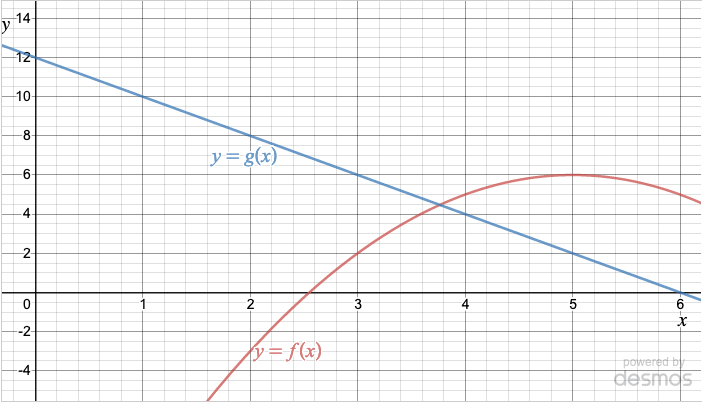
Limit Laws Question 1
Use the graphs of the functions f and g to find the requested limits.
Limit Laws Question 2
Find the following values given

You may have homework or an exam questions that require you to write out step-by-step which limit property you're using as you go from one line to the next. If so, we strongly suggest that you practice to become accostomed to the formalism before you have an exam, since you'll lose points if you don't get everything just the way your teacher wants. Look over your notes and practice replicating their examples.
For us, we're going to simply make use of the limit laws (without calling any extra attention to the fact that we're doing so) and move on to the various techniques you'll come to recognize you need in order to find a function's limit. We start on the next screen with the most straightforward of these: using "substitution" to find a limit.
The Upshot
- When finding limits, the limit of a sum-of-functions equals the sum of the limits-of-the-functions. Similar rules hold for the difference, product, quotient of functions, and so forth.
How helpful was this page?
Our goal is to provide the best content we can, for free to any student looking to learn well, and your feedback helps us improve.