B.2. Substitution to Find a Limit
Let's look at substitution to find a limit, the most straightforward technique we have to find a function's limit at a given point. You can of course practice using our problems with complete solutions.
This approach works when a function (1) is defined at the point of interest and (2) behaves smoothly near that point, meaning there are no jumps or gaps there. For example, let's consider these six functions, each at a different point:
- a linear function:
− 4 𝑥 + 2 𝑥 = 6 - a polynomial:
𝑥 3 − 5 𝑥 + 7 𝑥 = − 1 - a rational function (a quotient of two polynomials):
𝑥 3 − 1 𝑥 5 − 2 𝑥 3 + 1 𝑥 = 2 - an exponential function:
𝑒 − 𝑥 𝑥 = 0 . 5 - a logarithmic function:
l n ( 𝑥 2 + 1 ) 𝑥 = 0 - a trig function:
s i n ( 2 𝑥 ) 𝑥 = 𝜋 / 4 .
In each of these cases you can imagine a rough picture of the function's graph, and then see in your mind's eye how the value of the limit at the point of interest is simply equal to the function's value at that point.
The box below contains an interactive Desmos calculator for each of the functions above, with that function's particular point of interest marked. As you can see in each case, the limit simply equals the function's value at that point:
The key take-away:
As you saw in the examples above, when Substitution works you can find the limit easily, often in one line, which makes these problems quick. And we don't want to over-complicate that.
Remember:
A function's value at a point and its limit at that point are two distinct quantities.
At the same time, we want to emphasize again that
is a number L (if one exists) such that
We saw earlier various cases where
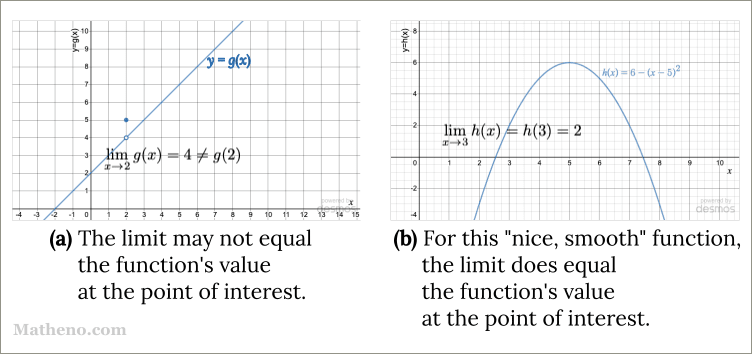
The following problems give you practice at finding limits using Substitution. We'll then examine a few complications below.
Substitution and one-sided limits
Let's consider a small complication that arises when we use Substitution to find a one-sided limit. The following example illustrates.
Example 1: One-Sided Limit
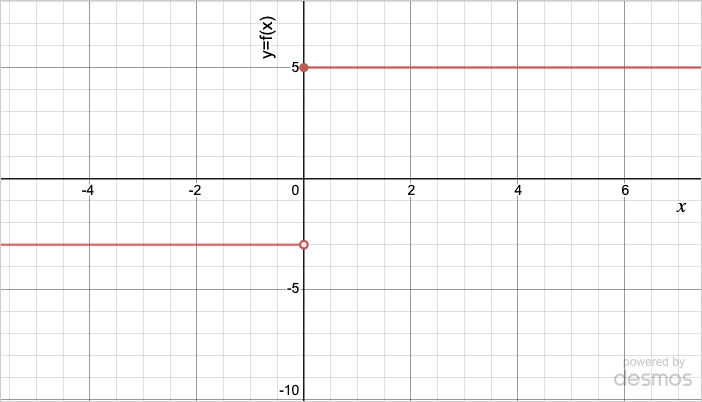
Recall the piecewise function we used to introduce one-sided limits:
We imagine that at this stage, if we ask you for the value of
Solution.
Clearly
But notice that
As Example 1 illustrates, when finding a one-sided limit at a point where the function's expression changes:
- if you're approaching
𝑥 = 𝑎 𝑥 → 𝑎 − 𝑥 < 𝑎 . - if you're approaching
𝑥 = 𝑎 𝑥 → 𝑎 + 𝑥 > 𝑎 .
We don't intend those bullet points as facts to memorize. Instead, they're just a reminder to keep the meaning of limits in mind when you answer these types of questions, rather than just mindlessly substituting.
 Because we're looking at the limit as
  We're aproaching
 What about when 𝑓 ( 𝑎 ) = n o n - z e r o n u m b e r 0 ,
Let's consider another complication: sometimes when you use Substitution to compute
Example 2:
Find
Solution.
Given our earlier work, you might immediately recognize that this function has a vertical asymptote at
The fact that you obtain "undefined" there does not automatically mean that the limit doesn't exist. Instead, it means we need to think more deeply: Substitution has failed as a tactic, and so we have more work to do.
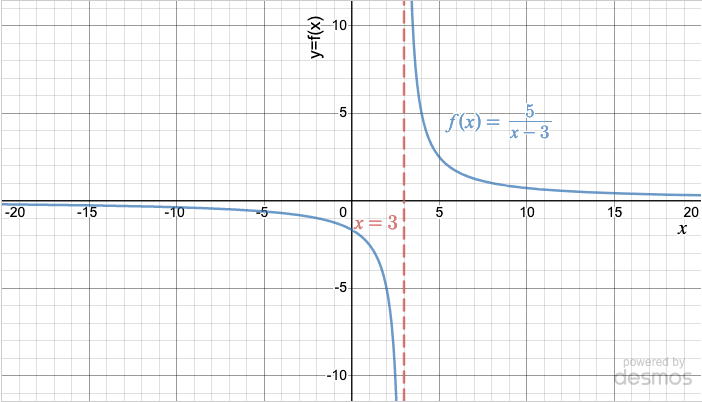
Specifically, once you obtain that particular result, you might now think: "Oh, right. The numerator is non-zero while the denominator goes to zero as
We're providing the graph to illustrate the conclusion, but again encourage you to make such thinking part of your repertoire so you don't have to graph every function to be able to reason correctly. Indeed, you are likely to encounter exam questions where you are not allowed to use a graphing calculator, and so such reasoning is required.
As the preceding example illustrates, when you substitute the limit-value into the function, if you obtain
As the next problem illustrates, while we may quickly conclude that the limit does not exist, the answer choices may require a bit of further reasoning.
 Since both the numerator and the denominator are squared-terms, we are guaranteed that the function always returns a positive value (except at
  As usual, we first try Substitution. Recall that
 Finally, what about when 𝑓 ( 𝑎 ) = 0 0 ,
Let's consider now an example where substitution gives the result
Example 3:
Find
Solution.
We begin, as usual, by trying Substitution:
Hmmm. We've seen that if we have
That's a different challenge. Let's pause this example for a moment. . .
In nearly all of your homework and test questions, when you try Substitution you'll obtain 0 divided by 0. You then need another tactic to find the limit.
The wrinkle: We wouldn't need the concept of the limit if you could always just substitute
Specifically, the
We'll look at the first, factoring, on the next screen. Before we do, we've seen the limit in the preceding example before. In fact we used that function to introduce limits. Do you remember what the graph of that function looked like, and how we quickly arrived at that graph? (No worries if not; we're about to revisit the key reasoning and then extend it.)
The Upshot
- When finding the limit
l i m 𝑥 → 𝑎 𝑓 ( 𝑥 ) , 𝑥 = 𝑎 𝑓 ( 𝑥 ) 𝑓 ( 𝑎 ) 𝑓 ( 𝑎 ) l i m 𝑥 → 𝑎 𝑓 ( 𝑥 ) = 𝑓 ( 𝑎 ) - When finding a one-sided limit at an x-value where the function's expression changes, be careful to choose the correct expression depending on whether you are finding the left-hand or right-hand limit.
- If you find
𝑓 ( 𝑎 ) = n o n - z e r o n u m b e r 0 ,
What questions or comments do you have about the material on this screen? Please head on over to the Forum and post!
How helpful was this page?
Our goal is to provide the best content we can, for free to any student looking to learn well, and your feedback helps us improve.