D.1 Continuity at a Point and Over an Interval
We turn now to an idea closely related to limits, and a concept that we'll use often and need to define: "continuity." As you'll see, whether we can apply certain tools to a function at a given point requires that we know that the function is "continuous" there, so we need to understand what continuity is!
Your everyday sense of "continuity" is quite useful for thinking about continuity in mathematics and science: time sweeps along continuously; river water flows continuously; "I biked continuously for twenty miles without stopping." The key idea is that there is no interruption in something that is continuous — no gaps, leaps, or sudden breaks.
If you can draw the curve without lifting your pencil from the page, the function is continuous
We can translate these everyday ideas to a simple way to determine if a function is continuous by considering its graph: if you can draw a function's curve without lifting your pencil from the page, then that function is continuous. For example, each of the functions in the following figure is continuous:

By contrast, a function is not continuous if it has a jump or gap somewhere. We label such functions discontinuous, and there are examples in the figure below. Notice that for each of these functions you cannot draw the curve without lifting your pencil from the page. (The circle around the "hole" in the first graph of course actually indicates that the function is undefined there, and isn't actually a part of the function: if we were walking up along this line, we'd have to leap over that gap, which makes the function discontinuous. )

A more mathematical way to think about continuity is to notice that for a continuous function, if we make a small change in the function's input (imagine moving your hand a bit to the right as you draw the graph), the function's output changes by a small amount (so you don't have to suddenly move where your pencil is to draw the next bit). In fact, if a function is continuous at a particular point, then starting from that point you can make the function's change-in-output as small as you'd like by making the change-in-input sufficiently small.
By contrast, if the function is discontinuous at a point (like at
The words, "make the change-in-output as small as you'd like by making the change-in-input sufficiently small" probably remind you of limits, as they should: the mathematical definition of "continuity" had to wait for the notion of "limit" to be developed, and relies heavily on that notion. Here is the official definition of Continuity at a Point:
Continuity at a Point
A function f is continuous at
First, for a function to be continuous at
That bottom graph thus highlights the importance of the limit in the definition of continuity. Applying our understanding of limits from earlier, in words the definition says: a function is continuous at
The Three Requirements for Continuity
As a practical matter, the continuity definition has three requirements. You should memorize these since an exam question about proving continuity automatically means that you must verify each of these:
Memorize these
𝑓 ( 𝑎 ) l i m 𝑥 → 𝑎 𝑓 ( 𝑥 ) l i m 𝑥 → 𝑎 𝑓 ( 𝑥 ) = 𝑓 ( 𝑎 ) 𝑥 = 𝑎 .
You can see how each function in the Discontinuous Examples figure above fails one of the requirements: In the top two figures, the function is not defined at
One-sided Continuity

Before then, let's introduce the idea of one-sided continuity, which is of course tied closely to the idea of one-sided limits. The figure to the right shows one of the example continuous functions from above,
More generally, one-sided continuity at a point is defined by
One-Sided Continuity at a Point
Let's consider an example to show how this all works in practice.
Example 1: Semicircle continuous at endpoints
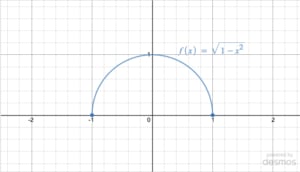
Consider the function
(i) continuous from the right at the endpoint
(ii) continuous from the left at
Solution.
We use the Three Requirements for Continuity, now as applied for one-sided continuity:
(i) At
𝑥 = − 1 l i m 𝑥 → − 1 + √ 1 − 𝑥 2 = √ l i m 𝑥 → − 1 + 1 − l i m 𝑥 → − 1 + 𝑥 2 = √ 1 − 1 = 0
and so exists.- Since
𝑓 ( − 1 ) = 0 , f r o m 2 . ⏞ ¯¯¯¯ ⏞ ¯¯¯¯ ⏞ l i m 𝑥 → − 1 + √ 1 − 𝑥 2 = 0 = 𝑓 ( − 1 ) .
Hence f is continuous from the right at
(ii) At
𝑥 = 1 l i m 𝑥 → 1 − √ 1 − 𝑥 2 = √ l i m 𝑥 → 1 − 1 − l i m 𝑥 → 1 − 𝑥 2 = √ 1 − 1 = 0
and so exists.- Since
𝑓 ( 1 ) = 0 , f r o m 2 . ⏞ ¯¯¯ ⏞ ¯¯¯ ⏞ l i m 𝑥 → 1 − √ 1 − 𝑥 2 = 0 = 𝑓 ( 1 ) .
Hence f is continuous from the left at
Quick aside about Substitution and Continuity
The preceding example actually contains a subtle point: do you remember when we first introduced Substitution as a tactic for finding limits we said, rather informally, that we were looking at "a function that is defined at the point of interest and that behaves smoothly near the point of interest, meaning there are no jumps or gaps there"?

We see now that what we were actually saying is that "if the function is continuous at
Continuity is crucial: we can only use certain tools where a function is continuous
Indeed, very soon we'll see that we can only apply certain Calculus tools (like substitution, and later differentiation and integration) if a function is continuous. Going forward, rather than saying a function is "nice and smooth, with no gaps or jumps," we'll say simply "the function is continuous at
Everything above has focused on a function's continuity at a point. Let's now consider continuity over an interval of some sort:
Continuity on an Interval
Continuity on open intervals
No surprise: If the function f is continuous at every number in the open interval
Similarly, if it is continuous at every number in the infinite interval
Continuity on closed intervals
We can extend these ideas to apply to continuity on a closed interval, simply by adding in the requirement that the function also be one-sided continuous at both endpoints of the interval:
Continuous on a closed interval
If a function f is defined on a closed interval
Example 1 (continued): Semicircle continuous over its entire domain
Consider again the function
Solution.
To show that f is continuous on the open interval
- f is defined on this interval.
- Consider an input-value
𝑥 = 𝑐 − 1 < 𝑐 < 1 . l i m 𝑥 → 𝑐 𝑓 ( 𝑥 ) = √ l i m 𝑥 → 𝑐 1 − l i m 𝑥 → 𝑐 𝑥 2 = √ 1 − 𝑐 2 - Still thinking about
𝑥 = 𝑐 𝑓 ( 𝑐 ) = √ 1 − 𝑐 2 , f r o m 2 . ⏞ ¯¯¯¯ ⏞ ¯¯¯¯ ⏞ l i m 𝑥 → 𝑐 𝑓 ( 𝑥 ) = √ 1 − 𝑐 2 = 𝑓 ( 𝑐 ) 𝑥 = 𝑐 ( − 1 , 1 ) . ◂
We already showed above in Example 1 that f is one-sided continuous at its endpoints
Hence f is continuous on its entire domain
Practice Problems: Continuity at a Point and Over an Interval
Time for some practice problems so you can consolidate the ideas here for yourself. Most students find problems that ask you to that a function is continuous a little awkward at first, but — as with most things — become less so with practice.
 If you are going to be tested on continuity, make sure you know how to complete Problems #4 and #5, which are extremely common on exams.
I.
II.
III.
IV.
✓ II.
✓ III.
✗ IV.
Hence the true statements are I, II and III
3.
The graph below shows how the two pieces of the function meet at
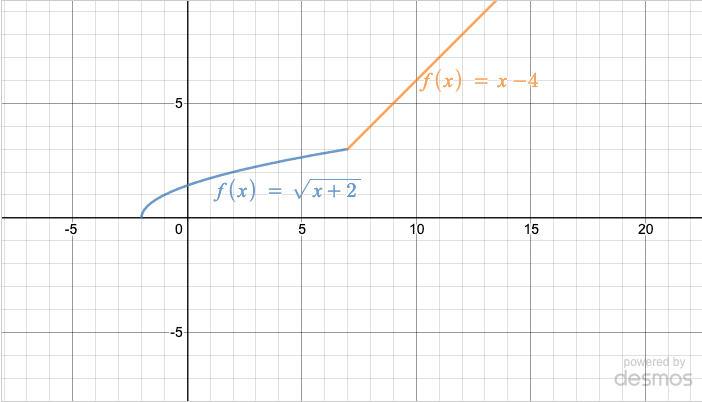
I. Continuity on
1.
[indent] 1. The function is defined at
2.
III. Continuous from the right at
[indent] 1. The function is defined at
2.
Having shown I, II and III, we have shown that f is continuous on the closed interval
The next few problems are typical exam questions.
Let f be the function defined by
Find the value of k such that f is continuous at
View/Hide Solution
Although it's not required, let's step through the requirements for f to be continuous at
1.
3.
For f to be continuous at
To generate the other, let's look at
Let's substitute that value for b into our equation marked
Just for completeness, let's check to make sure those values are correct:
On the next screen we'll give names to the different types of discontinuities, and see how to "remove a discontinuity." On the screen after that, we'll discuss continuous functions (including providing a list of functions that simply are continuous on their domains, which is super-helpful to know).
For now, what questions or comments do you have about the material on this screen, or any other Calculus concepts? Please join the discussion over on the Forum!
The Upshot
- Informally, a function is continuous if you can draw its curve without lifting your pencil. Formally, a function f is continuous at
𝑥 = 𝑎 l i m 𝑥 → 𝑎 𝑓 ( 𝑥 ) = 𝑓 ( 𝑎 ) - To prove that a function is continuous at
𝑥 = 𝑎 , 𝑓 ( 𝑎 ) l i m 𝑥 → 𝑎 𝑓 ( 𝑥 ) l i m 𝑥 → 𝑎 𝑓 ( 𝑥 ) = 𝑓 ( 𝑎 ) 𝑥 = 𝑎 .
- For one-sided continuity, we consider only the limit from the left or from the right:
C o n t i n u o u s f r o m t h e r i g h t a t 𝑥 = 𝑎 : l i m 𝑥 → 𝑎 + = 𝑓 ( 𝑎 ) C o n t i n u o u s f r o m t h e l e f t a t 𝑥 = 𝑎 : l i m 𝑥 → 𝑎 − = 𝑓 ( 𝑎 ) - A function is continuous on the open interval
( 𝑎 , 𝑏 ) [ 𝑎 , 𝑏 ] ( 𝑎 , 𝑏 ) l i m 𝑥 → 𝑎 + 𝑓 ( 𝑥 ) = 𝑓 ( 𝑎 ) a n d l i m 𝑥 → 𝑏 − 𝑓 ( 𝑥 ) = 𝑓 ( 𝑏 )
How helpful was this page?
Our goal is to provide the best content we can, for free to any student looking to learn well, and your feedback helps us improve.