D.2 Discontinuity Types; Removable Discontinuities
Let's now give names to the different types of discontinuities we saw earlier, and look at removable discontinuities.
Types of discontinuities
Recall that we saw on the preceding screen three examples of discontinuities. Each is an example of a different type:
- Each of the top two figures below shows a removable discontinuity: the graph has a single hole in it at
𝑥 = 𝑎 𝑓 ( 𝑎 )

- The bottom-left figure shows an infinite discontinuity:
l i m 𝑥 → 2 − = − ∞ l i m 𝑥 → 2 + = ∞ . l i m 𝑥 → 𝑎 − = ± ∞ l i m 𝑥 → 𝑎 + = ± ∞ - The bottom-right figure shows a step or gap continuity: the function has a finite difference in the limit as
𝑥 → 𝑎
There isn't much to say about infinite discontinuities or step (or gap) continuities, so we're going to focus on removable discontinuities here. (They're also the ones that usually appear on exams.)
Removable discontinuities
You've actually already been working with removable discontinuities, and have even already "removed the discontinuity" many times now; we just didn't yet have the concept or term "discontinuity" to describe the process we used. The following Example will seem familiar and demonstrates what we mean.Example 1: Remove the discontinuity from
The function
Let's redefine the function to be
Find the value of c that makes the function continuous.
Solution.
Recall that for f to be continuous at
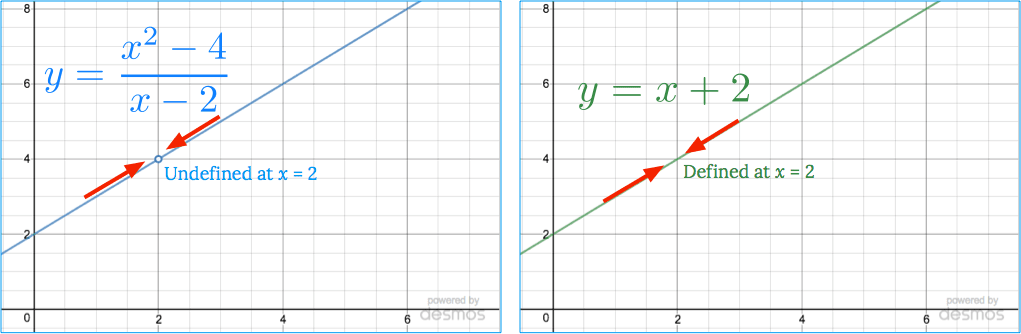
You've probably done enough of those types of limit problems by know to be able to complete the steps as well as we can: first factor the function's numerator, and then reduce the fraction, to find
Recall that we wrote after that first "Factoring" example:
As you will see in many, many problems to come, we will use this basic technique often: through algebraic manipulation, we are able to rewrite a function into a different form which is defined at the point of interest. Simple substitution then works to know the value of the function at that point, which in turn is the limit of the function at that point.
There is an important subtlety here: the two functions in the graphs above are not the same because they have different domains: the original function,
And because we explicitly don't care about what's happening at
This is almost the only time we'll discuss this subtlety, but you should keep in mind that the algebraic manipulations you'll do again and again allow us to find the limit of the original function only because of the way the limit is defined to focus on the behavior of the function close to, rather than at, the point of interest.
Hence earlier, when we were focused only on the limit, we weren't changing the function itself and so
Notice that this means we now have two ways of writing the function:
The two expressions are now entirely equivalent.
You should be prepared for an exam question similar to that of Example 1. Since you're now so good at finding limits, you know what to do: find the limit at the point of interest

The problems below provide practice. Note that most are from actual previous university-level exams, and we note as we did on the preceding screen that you should expect such problems on your exams.
Practice Problems: Removable Discontinuities

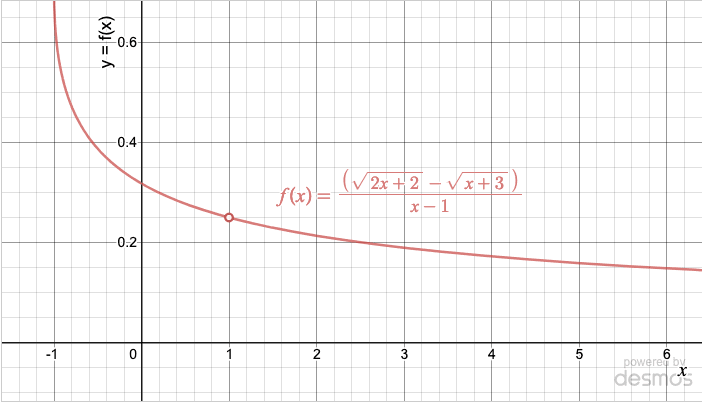
 Consider the function f shown. Which of the following statements are true?
I. f has a removable discontinuity at
Consider the function f shown. Which of the following statements are true?
I. f has a removable discontinuity at II. f has a removable discontinuity at
III. f has a jump discontinuity at
IV. f has an infinite discontinuity at
Redefining the single point of the function such that
II. f has a removable discontinuity at
Even if we "filled in the hole" at
III. f has a jump discontinuity at
Since
IV. f has an infinite discontinuity at
Hence the only true statements are I and IV

On the next screen we'll discuss various continuous functions.
For now, what questions or thoughts do you have about discontinuities? Or are you working on a homework problem where you have to make a function continuous? Please join us over on the Forum to discuss!
The Upshot
- The three types of discontinuities are (1) "removable," (2) "infinite," and (3) "jump," or "gap."
- If a function has a removable discontinuity at
𝑥 = 𝑎 , 𝑓 ( 𝑎 ) = l i m 𝑥 → 𝑎 𝑓 ( 𝑎 ) .
How helpful was this page?
Our goal is to provide the best content we can, for free to any student looking to learn well, and your feedback helps us improve.