D.4 The Intermediate Value Theorem
To conclude our study of limits and continuity, let's introduce the important, if seemingly-obvious, Intermediate Value Theorem, and consider some typical problems. We'll need the theorem later for some of our more important Calculus-y proofs, but even on this screen we'll see some surprising implications. (At the bottom of this screen, we'll look — optionally — at how Desmos graphs are often misleading essentially because of misuse of this theorem. No knock on Desmos, which we love and use a lot as you've seen! Even they say you must be aware of its limitations, including the ones we'll see below.)
To understand the theorem, take a look at the top figure: the function f is continuous on the interval
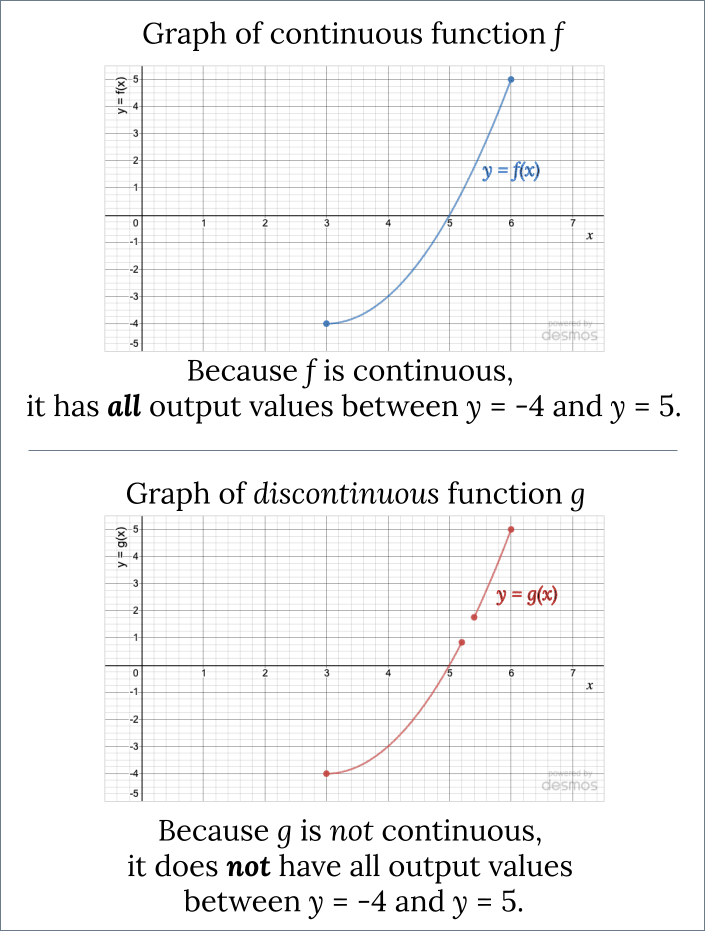
By contrast, the lower figure shows the function g which is not continuous on the same interval
IVT = Intermediate Value Theorem
The simple contrast between the functions f and g here illustrates an extremely important consequence of a function being continuous, and that consequence is captured by the Intermediate Value theorem (which we'll frequently abbreviate as "IVT"):
A common use of the IVT is to prove that an equation has at least one solution, even if you don't immediately (or ever) know what that solution is. The next example illustrates.
Example 1: Solution existence
Show that the equation
Solution.
Notice that the question doesn't ask us to find the solution; instead, it asks us to show that a solution exists. This is a strong clue that we should use the IVT.
First, let
Next, let's compute the value of f at the endpoints of the interval
Perfect: the question asks us to show that a solution exists for
Since f is continuous and
![Graph showing the point (1,9) and text: We know for the interval [1, 2] the curve starts here. Then the point (2, 6) with the text: and ends here. More text: Since f is continuous, we thus know by the Intermediate Value Theorem that the curve _must_ include a point with y=8. (We don't know where exactly, but we know the point exists](https://res.cloudinary.com/dmutw7qs5/image/upload/b_white/c_limit,w_757/f_auto/q_auto/v1/remote_images/INT-Ex1.png?_a=BBGAGRGX0)
We note the following corollary to the IVT which is often easier to use in practice:
If f is continuous on
The corollary is useful because if you yourself have to supply the values of a and b, initially by just guessing, then it's easier to try and hone in on values with the goal of finding just one output-value that's negative and one that's positive. You then know that the curve must cross the x-axis somewhere between your two input values. The following example illustrates, and also introduces one super-helpful problem-solving tip.
Example 2: Solution exists for
Show that there is at least one solution to the equation
Solution.
Notice again that the question doesn't ask us to solve the equation, but rather to show that a solution to
A VERY HELPFUL initial move is to rewrite the given equation and introduce a new function
We now just start guessing at values of a and b with the goal of finding outputs with opposite signs, since that guarantees that there is a value of c between a and b such that
So let's start guessing. The easiest number to try is 0:
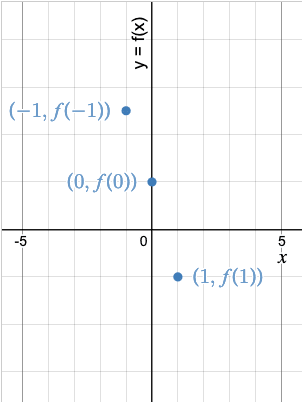
Oops: that didn't help, since we got another positive output. No matter: let's try another value, going to the positive-side of
and let's try

Example 2 illustrates the helpful move of defining a new function f (or g or whatever) at the start of a solution so you're looking for a value of c such that
The following example is another illustration of this helpful tactic — and also an example of how we can apply the IVT to some surprising scenarios.
Example 3: Height and weight with equal values?
True or False? At some time t since you were born, your weight in pounds equaled your height in inches.
Solution.
This question seems out-of-the-blue . . . but we note that this question again doesn't ask for the value of the time t, and instead just asks about whether such a moment exists. And that again is a clue to use the IVT.
One way to show that this statement is true is to, following the Problem-Solving Tip, define a new function that is the difference between the two quantities of interest. So let's define a function that's the difference between your weight as a function of time, and your height as a function of time:
Now, note that at birth,
Hence by the Intermediate Value Theorem, there must be some particular moment T between your birth and now when
Note that we don't know when that moment was, only that it must exist.
Here are some practice problems for you to try.
Practice Problems: Intermediate Value Theorem
Note: You may not use a calculator to answer this question.
The next problem is often found in textbooks, and sometimes on exams.
First, note that the question is not asking you to find this number; instead, it is asking whether such a number exists. And that is a BIG CLUE we should think about the Intermediate Value Theorem (IVT). With that in mind, we start by expressing the statement mathematically:
Is there some number,
As we noted above, when asked whether two expressions are ever equal, it's helpful to define a new function that is the difference between those two expressions. Hence we define
Note that since
So now, we just try out some numbers and see what happens. The easiest number to try is 0:
Now let's look for
Having exhausted those really-easy numbers to try, let's stop and think a bit: we want
"For the function
Furthermore, although the question doesn't ask us to go any further, we actually have shown that the value of x we're after lies in the range
 To make our argument more formal, let the function
 This next problem is a little mind-blowing, at least to us, but follows the same type of reasoning as the preceding questions.
If you were to encounter this or a similar question on an exam, we suggest just jumping in with the hint and seeing where it takes you. (Don't just stare at the blank page; start by writing down something that the problem told you!) The hint was
We promised at the top of the screen a discussion of a way in which Desmos and other graphing programs are sometimes entirely misleading. Open the box if you're interested:
What questions or comments about the IVT, or continuity, or limits do you have? Please pop over to the Forum and join the discussion with the rest of the community, including us!
The Upshot
- The Intermediate Value Theorem (IVT) states the obvious fact that: If a function f is continuous on a closed interval
[ 𝑎 , 𝑏 ] 𝑓 ( 𝑎 ) ≠ 𝑓 ( 𝑏 ) , 𝑓 ( 𝑎 ) 𝑓 ( 𝑏 ) [ 𝑎 , 𝑏 ] . - Its corollary is often more useful in practice: If f is continuous on
[ 𝑎 , 𝑏 ] 𝑓 ( 𝑎 ) 𝑓 ( 𝑏 ) 𝑓 ( 𝑐 ) = 0 . - A very strong clue to use the IVT (or more likely, its corollary) is that a problem statement asks you to "show that a solution exists," or that the function takes on a particular output-value somewhere between two input-values; the problem does not ask you to find the solution, or the specific input-value where the output-value occurs. For such problems, use the steps outlined in the Examples and Practice Problems above.
Chapter Conclusion, and What's Next
And with that, we conclude our study of limits and continuity.
Recall that we ended Chapter 1 here:
The Upshot (at the end of Chapter 1)
- A function's average rate of change over an interval is equal to the slope of the secant line that passes through the endpoints of the interval:
a v e r a g e r a t e o f c h a n g e [ 𝑥 1 , 𝑥 2 ] = s l o p e o f l i n e s e g m e n t = Δ 𝑦 Δ 𝑥 = 𝑓 ( 𝑥 2 ) − 𝑓 ( 𝑥 1 ) 𝑥 2 − 𝑥 1 - You can make the average rate of change arbitrarily close to the instantaneous rate of change at
𝑥 1 𝑥 2 𝑥 1 Δ 𝑥
These points raise a natural question that led to the development of Calculus itself:
How small can we make
We know it can't be exactly zero, because we can't divide by zero in the slope calculation. So how small can we make it?
We will take up this key question — arguably THE key question — when we explore THE key tool in Calculus in the next Chapter, on "Limits".
We now have that we have that foundational tool of limits — without which Calculus wouldn't exist! — and so we can return to that question. The answer will lead us to develop one of the (only) two fundamental concepts of Calculus, the derivative, in the next Chapter. . . which we will have available soon. We will be excited to see you there when it's ready — please watch the Forum for the announcement when it's available.

For now, we hope you'll have a small celebration for yourself: understanding the concept of "the limit" deeply means understanding one of the great triumphs of science and mathematics. (There's a reason the founders of Calculus are so celebrated!) We sincerely hope we've helped you lay a firm foundation for yourself from which to build the key ideas to come. If you would be so kind, please let us know on the Forum: we really need and appreciate your feedback.
And please don't forget that celebration part!
How helpful was this page?
Our goal is to provide the best content we can, for free to any student looking to learn well, and your feedback helps us improve.