C.5 Limits of Polynomials
On this screen we're going to see how to reason quickly about the limit of polynomials as x goes to positive or negative infinity, relying on a concept known as "dominance" as applied to polynomials. We'll also show you how to prove such results more formally. For both reasoning paths we'll make direct use of the conclusions from the preceding two screens (limits as some limits as
More specifically, on the preceding screens we developed the skills we need to determine the limits of a monomial, like
Let's explore the behavior of this function to illustrate the general approach to finding such limits.
Consider the function
What do you think its limit is as
Even if you're not sure of the answer, what features of the function are you drawn to think about in considering its behavior as x grows and Grows and GROWS larger and Larger still?
Informal, quick reasoning
One thought you might have had is that behavior of the term with the largest power,
Such an insight is correct, as you can see using the interactive graph below: The solid red curve shows
For example, at Zoom Level 4, the two curves look like they overlap entirely for large enough x. Let's consider the two functions' outputs at
Looking term-by-term, we see that at
Furthermore, remember that
This is all to say that as x grows larger, the term with the largest power
This informal reasoning will allow you to determine the limit quickly and is often the only approach you need: you read the question, look at the polynomial, decide what dominates, and immediately know the answer. You'll of course be able to practice this below.
Formal development of the limit
The informal reasoning above is clearly not a rigorous determination of the limit. We can do that easily enough as well, though, using a simple tactic: First factor out the largest-power term, in this case the
Then recall that
And that's our proof that the limit of this polynomial is
Dominance: focus only on the term with the largest power
The key point of the Exploration above is that, when considering

For instance, for the function above
Let's summarize how we use the concept of dominance both informally and formally:
For quick informal reasoning, use dominance and just look at the largest term:
For formal development of the limit: Factor out the largest-power term that dominates, and then use what you know about the resulting limits for
You'll be able to practice these approaches below. Before then, let's extend our ideas to apply to
What is
You can again use the interactive Desmos calculator below, and the "Zoom Out" buttons, to explore your initial thoughts.
Informal, quick reasoning
As above, when thinking about the limit we can focus only on the largest term that dominates:
Formal development of the limit
Also as above, we first factor out the largest-power term that dominates, and then recall that
Exactly as above, we can summarize the reasoning for both informal and formal development of the limit:
For quick informal reasoning:
For formal development of the limit, factor out the largest-power term and then use what you know about the resulting limits for
Of course there are other types of functions in the world besides polynomials; for instance, rational functions (as you know) are fractions of polynomials. We'll see how to extend the ideas of dominance to determine the limit as
For now, practice using the ideas from this screen in the following few problems. We recommend (1) quickly deciding the answer using informal reasoning, and then (2) put pencil-to-paper and to practice finding the limit more formally, which you'll probably need to do on an exam. You'll discover the solution only takes 2-3 lines, and once you've done a few of these you'll have the technique down for yourself.
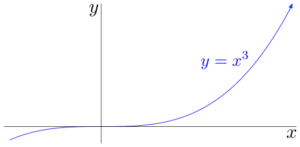

The Upshot
- When considering the limit on a polynomial as
𝑥 → ∞ 𝑥 → − ∞ , - With that focus in place, you can immediately deduce the limit of any polynomial, after recalling (or picturing in your head) the behavior of that largest term:
l i m 𝑥 → ∞ ( 𝐴 𝑥 𝑁 + ( s m a l l e r t e r m s ) ) = l i m 𝑥 → ∞ 𝐴 𝑥 𝑁 l i m 𝑥 → − ∞ ( 𝐴 𝑥 𝑁 + ( s m a l l e r t e r m s ) ) = l i m 𝑥 → − ∞ 𝐴 𝑥 𝑁 - To develop the required limit more formally, factor out the largest-power term and then proceed.
Please join the discussion over on the Forum for any questions about dominance, or any other concepts involving
How helpful was this page?
Our goal is to provide the best content we can, for free to any student looking to learn well, and your feedback helps us improve.