C.2 The Epsilon Strip
On this screen we're going to introduce a new tool, "the epsilon strip" [Ref], that will help us determine whether a limit at infinity (or negative infinity) exists. To motivate and illustrate the use of the tool, we're going to use Desmos to consider a single oscillating function. We'll then use the tool to examine other functions on the next screen.
Sample function that oscillates forever
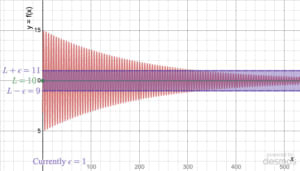
The single function f that we're going to consider on this screen is plotted in the graph immediately below, and as you can see, it oscillates forever. Looking at the graph, do you think
When you have your answer in mind for yourself about whether the limit exists or not, please continue to the student dialog below.
Two students discuss whether the limit the exists:
LAKEESHA: As x gets bigger and bigger, the function's output tends to
MISHA: I think they're trying to trick us again. See how the function keeps oscillating no matter how far out you go? The oscillations get smaller and smaller, but they're always there, so the function keeps crossing that horizontal line at
Do you have your answers in mind? If not, please pause here to re-read Lakeesha and Misha's statements and think through for yourself what each is saying. When you're ready, read on:
We know that Misha's reasoning matches that of many students who are first learning about limits at infinity — and even if you don't agree with her, you can probably understand how a smart student could (mis)conclude that the limit doesn't exist since the function's output values keep oscillating. It's a fair initial reaction! But once again, we must go beyond such initial reactions and look to the definition of the limit in order to make a reasoned judgement:
The limit at infinity exists and equals Lif,
for any value of
there is a value of M such that for all
the function's output values lie in the range
And by this definition, the limit does exist, and
With the initial zoom-level set, we see many values of
When you're ready, you can use the buttons above to change the size of
- when
𝜖 = 0 . 1 , 𝑀 = 8 0 0 1 0 − 0 . 1 < 𝑓 ( 𝑥 ) < 1 0 + 0 . 1 . - when
𝜖 = 0 . 0 2 , 𝑀 = 1 1 0 0 1 0 − 0 . 0 2 < 𝑓 ( 𝑥 ) < 1 0 + 0 . 0 2 . - when
𝜖 = 1 × 1 0 − 8 , 𝑀 = 4 0 0 0 1 0 − ( 1 × 1 0 − 8 ) < 𝑓 ( 𝑥 ) < 1 0 + ( 1 × 1 0 − 8 ) .
We're so zoomed-in for that last value of
We imagine that you can see the utility of being able to see the epsilon strip in the graph above, and roughly determine, quickly, the value of M for the current
Importance of the value of L
Another feature of the epsilon strip is that we can use it to find, or check, the value of L itself. For instance, in the interactive graph below we've set the value of L to incorrectly be
You can use the button beneath the graph to set
Ah: now with
You can imagine that we could continue to try different values of L, and would eventually conclude that the only value that works for any value of
With this result in mind, let's restate our definition of the Limit at Infinity, now with an emphasis on L:
The limit at infinity exists and equals Lif,
for any value of
there is a value of M such that for all
the function's output values lie in the range
If the limit exists, it is a single value L that satisfies the above criterion.
On the next screen, we'll look at some functions for which the limit at infinity exists, and other functions for which it does not.
The Upshot
- The "epsilon strip" is a tool we can use to determine visually whether a limit at infinity exists and equals L. The strip is centered on L and has vertical width determined by whatever
𝜖 𝑥 > 𝑀 , 𝑥 → − ∞ .
Questions or comments about this new tool, the epsilon strip? Please join us on the Forum to discuss!
- Full credit to Kyeong Hah Roh for developing the epsilon strip:
Kyeong Hah Roh (2010) "How to Help Students Conceptualize the Rigorous Definition of the Limit of a Sequence," PRIMUS, 20:6, 473-487 - We appreciate Matthew Voigt for illustrating the use of the epsilon strip with Desmos:
Matthew Voigt (2016) "Exploring Students' Understanding of the Limit of a Sequence Through Digital and Physical Modalitites." Wood, M. B., Turner, E. E., Civil, M., & Eli, J. A. (Eds.). (2016). Proceedings of the 38th annual meeting of the North American Chapter of the International Group for the Psychology of Mathematics Education. Tucson, AZ: The University of Arizona.
How helpful was this page?
Our goal is to provide the best content we can, for free to any student looking to learn well, and your feedback helps us improve.