A.1 Introduction to Limits
Let's dive right in and examine a simple function so we can make the distinction between a function's output-value at a given input-value, and its limit-value near that same input-value. We'll of course also address errors students often make when first learning about limits
An initial function to examine: 𝑓 ( 𝑥 ) = 𝑥 2 − 4 𝑥 − 2
To begin our study of limits, let's consider a single function,

Why is the graph a line? Notice that we can factor the numerator, and so
Question: Looking at the graph, what does
Before proceeding, ask yourself what thoughts are going through your head. Many people find themselves feeling torn, or can at least imagine someone feeling torn.
On the one hand, you know that
On the other hand, a part of you may want to say "
First, let's be perfectly clear:
And yet there is more information to be had. We can say absolutely correctly, for instance,
"
"We can get as close to
"The limit of
And that is our first mathematically correct "limit statement."
The limit says nothing about the value at x = 2.
Notice that this limit statement says nothing about the value of
The interactive graph below allows you to explore these statements dynamically. You can change the x-value of the red dot (initially at x = 0.94), and the point's label automatically displays the
"We can get as close to
by getting sufficiently close to x = 2."
You may tire of zooming-and-moving-closer. If not, you'll probably find that even Desmos will only let you zoom in so far. Either way, continue to imagine the zooming-and-moving-closer process in your mind, so that even if we asked you to get to within, say, 0.000000000001 of
Generalizing to a working definition of "limit"
This may all seem seem conceptually simple to you — if so, great. (And if not, no worries: we're going to be developing increased understanding as we continue, so please keep going.) At the same time, it took mathematicians a tremendous amount of work and hundreds of years — truly, hundreds of years — to develop the precise formal definition of "limit" that we use today. We in turn have work to do to develop a deeper understanding of the simple conceptual ideas we've introduced here. Let's first state our working definition of "limit" that we can apply to any function [Ref 1]:
Working Definition of Limit
The limit of the function
such that
wheneverx is sufficiently close to a.
For example, for the function we considered at the top of this screen,
Question #1: Function's value versus limit value
Consider the function Consider the function
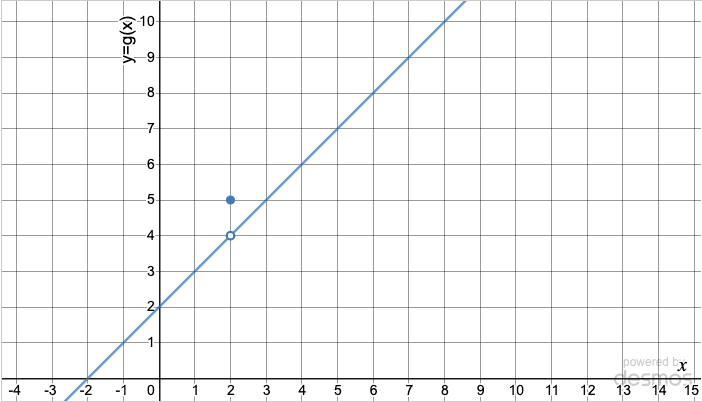
The limit of a function at a point and the function's value at that point need not be the same value.
As Question 1 illustrates, the limit of a function at a point and the function's value at that point need not be the same value.
Let's consider a similar question.
Question #2: Function's value versus limit value
Consider the function

As we see in Question 2, the limit of a function at a point can simply equal the function's value at that point, and often does. None the less, it is critical that you recognize that the two quantities
So far on this screen we've used graphs to see easily what a function's limit is at a given point. You of course won't always have such a graph available, and there are other ways to provide data about a function. For instance, on exams you should expect questions that present you a table of values instead. The next question illustrates.
Question #3: Limit from a table
The table below shows some input and output values for a particular function
| x: | 2.7 | 2.8 | 2.9 | 3.0 | 3.1 | 3.2 | 3.3 |
|---|---|---|---|---|---|---|---|
| | 0.2549 | 0.2532 | 0.2516 | undefined | 0.2485 | 0.2470 | 0.2455 |

Regarding Question #3, you might be thinking that you cannot know for sure that the answer is
Common misunderstandings of "limits"
Before we leave this screen, let's address a few common ideas students have when they're first learning about limits in Calculus [Ref 2].
We wanted to raise the true/false question right here on this introductory screen because the word "limit" itself has everyday, non-math usage that we should acknowledge: for example, "speed limit," "I have limited free time," and "I'm at my limit." That is, in everyday usage a "limit" is something that you typically do not (or should not, anyway) exceed. The mathematical meaning is different, as we can see from our current working definition:
The limit of the function
wheneverx is sufficiently close to a.
From this definition, we can certainly have values above, and below, the limit-value at a particular point. Hence just keep in mind that you should be careful when applying your everyday ideas of "limits" to our new mathematical usage.

On this screen we've been using our working definition of "limit" (repeated immediately below) that is conceptually appealing and, for many, easy to understand. At the same time, the phrases "as close to" and "sufficiently close" are vague, leaving them open to different interpretations. That is, while this is a fine place to end this introduction to limits, those phrases are not mathematically precise. We'll start to define them more clearly on the next screen .
The Upshot
- In our introduction to limits, we have developed a working definition:
The limit of the function
𝑓 ( 𝑥 ) l i m 𝑥 → 𝑎 𝑓 ( 𝑥 ) = 𝐿 ,
such that𝑓 ( 𝑥 )
wheneverx is sufficiently close to a. - Common, everyday ideas of "limit" do not apply to our mathematical notion of "limit."
- Oehrtman, M. (2009). "Collapsing dimensions, physical resistance, and other metaphors of limit, concepts." International Journal of Mathematical Education in Science and Technology, 40(3), 397-426.
- R.B. Davis and S. Vinner. The notion of limit: some seemingly unavoidable misconception stages. Journal of Mathematical Behavior, 5(3):281-303, 1986.
How helpful was this page?
Our goal is to provide the best content we can, for free to any student looking to learn well, and your feedback helps us improve.